I wrote this article, which ought to be regarded from a psychological perspective —-the ever-present tensions between the civilized and uncivilized— during the outbreak of Covid-19, 2020.
I was so frightened by the transmissibility of the virus that I felt compelled to writing about my fears and angsts, hence the title.
In earnest, it is a self-critical analysis of my mind as gripped by the soul-wracking thoughts of death and annihilation. And it is proof, as observed by renown German author, Thomas Mann, that some of our most felicitous artworks and writings could emerge but during difficult times and hardships.
Unbeknownst to my humble smattering of psychology, the fear of dying led me to plumb deep into the field of psychology, mental sanity and despair.
The Caveman at the Crossroads of Millennia, albeit a rather short essay, is still waiting for the daystar of recognition. It is followed by --On the Crisis of Our Times and the Possibility of Contact with Extraterrestrial Life— as one of those essays where I may shine not just as mere writer, or a scribbler of metaphysics, but as a thinker who can see universals, nay, one who can step out of the high-walls of urban society to apprehend recurrent events and motifs in the rise and fall of civilizations. .
Therefore, it is the only essay, however rising across the pavilions of millennia, where I may suspect me to be a genius, or a caveman-artist, beyond the appraisal or reproach of my contemporary: the gatekeeper of the established academia of our time.
I dedicate this short essay On Cave-Paintings to a great human being, today, a marvelous cave-dweller, a wonderful, indefatigable artist, a great cook, a tenacious survivalist! He lived thirty thousand years ago, but his artwork continues to fill us with hope and inspiration!
I was so frightened by the transmissibility of the virus that I felt compelled to writing about my fears and angsts, hence the title.
In earnest, it is a self-critical analysis of my mind as gripped by the soul-wracking thoughts of death and annihilation. And it is proof, as observed by renown German author, Thomas Mann, that some of our most felicitous artworks and writings could emerge but during difficult times and hardships.
Unbeknownst to my humble smattering of psychology, the fear of dying led me to plumb deep into the field of psychology, mental sanity and despair.
The Caveman at the Crossroads of Millennia, albeit a rather short essay, is still waiting for the daystar of recognition. It is followed by --On the Crisis of Our Times and the Possibility of Contact with Extraterrestrial Life— as one of those essays where I may shine not just as mere writer, or a scribbler of metaphysics, but as a thinker who can see universals, nay, one who can step out of the high-walls of urban society to apprehend recurrent events and motifs in the rise and fall of civilizations. .
Therefore, it is the only essay, however rising across the pavilions of millennia, where I may suspect me to be a genius, or a caveman-artist, beyond the appraisal or reproach of my contemporary: the gatekeeper of the established academia of our time.
I dedicate this short essay On Cave-Paintings to a great human being, today, a marvelous cave-dweller, a wonderful, indefatigable artist, a great cook, a tenacious survivalist! He lived thirty thousand years ago, but his artwork continues to fill us with hope and inspiration!
Since I have been confined to my solitude for more than thirty days, and knowing that so many others have perhaps escaped the scourge of our times, my existence has rather been marked by short intervals of peace, I shall say interludes of music, preludes to my soul, scarcely disturbed by the noisy winds of the world. Most importantly, of much concern has been the well-being of my friends and family, because I am not oblivious to the real dangers haunting us all.
Days and nights! I have paced my room, back and forth, with pensive steps, going around the same narrow circumference of my thoughts, but the prodding ticks of time has not, as yet, harrowed my placid assurance in the comprehension of my heartbeats' anticipation, for they seem to keep a "moderate tempo" in the unrolling scroll of my life. In other words, I am still optimistic. Books and food are still coming-in to replenish my inward shelves, and I am still activated by a sound health, a blessed frame of mind, which is enlivened by its own supply of warmhearted thoughts as yet waiting for better days to come.
While living in solitude, I can say that I have not been wanting of faithful friends, indispensable companions of existence, whose love for me has been the most attentive, caring and helpful in times of trials and tribulation. The haunting ghosts of foreboding and vexation I have been able to ward-off, but I have often fixed my doubts-stricken eyes upon the lingering hours of the calendar's slowly turning pages, and as I mark the passing days, a multitude of huddling feelings, a sense of prophetic urgencies, have pressed on within me with an incomprehensible mixture of uncertainties and thrills: an unfolding new I am, occasioned by fleeting shivers of enthusiasm! Eastern is soon approaching, and would Mother Nature deny herself a colorful skirt of blooming flowers and roses?
Meanwhile, the continuation of time, human history as conveyed to me by the Cave-Artworks of the ancient people, so rubbed by the long-wailing winds of the elements and millennia, has caused me to pause in meditation and reflections ---my heart contracts, as though pierced and shriveled- off by the cave-solitude of one thousand years. Fixed in cogitation deep, the meaning of those errant winds, messengers of woes and trepidation, could still test the mettle of any mortal.
Days and nights! I have paced my room, back and forth, with pensive steps, going around the same narrow circumference of my thoughts, but the prodding ticks of time has not, as yet, harrowed my placid assurance in the comprehension of my heartbeats' anticipation, for they seem to keep a "moderate tempo" in the unrolling scroll of my life. In other words, I am still optimistic. Books and food are still coming-in to replenish my inward shelves, and I am still activated by a sound health, a blessed frame of mind, which is enlivened by its own supply of warmhearted thoughts as yet waiting for better days to come.
While living in solitude, I can say that I have not been wanting of faithful friends, indispensable companions of existence, whose love for me has been the most attentive, caring and helpful in times of trials and tribulation. The haunting ghosts of foreboding and vexation I have been able to ward-off, but I have often fixed my doubts-stricken eyes upon the lingering hours of the calendar's slowly turning pages, and as I mark the passing days, a multitude of huddling feelings, a sense of prophetic urgencies, have pressed on within me with an incomprehensible mixture of uncertainties and thrills: an unfolding new I am, occasioned by fleeting shivers of enthusiasm! Eastern is soon approaching, and would Mother Nature deny herself a colorful skirt of blooming flowers and roses?
Meanwhile, the continuation of time, human history as conveyed to me by the Cave-Artworks of the ancient people, so rubbed by the long-wailing winds of the elements and millennia, has caused me to pause in meditation and reflections ---my heart contracts, as though pierced and shriveled- off by the cave-solitude of one thousand years. Fixed in cogitation deep, the meaning of those errant winds, messengers of woes and trepidation, could still test the mettle of any mortal.
Cold winds are still buffeting the sore gullets of my inner fortification, but they have not chilled me into a melancholy frame of mind, nor have they frozen my heart into a pessimistic worldview on the general condition of human existence.
I am still activated by a "deep-seated stir," a spirit of curiosity has taken grasp of me, and I am willing to come to grips with a caveman, and let us the two compare the ages, and if he is found to be happier than me, then let him instruct me on the source of his happiness. But if he is to be found wretched, lonely and barking all daylong like a dog, then let us come together and perhaps find solace in this mutual conversation across the wordless language of millennia.
The caveman is within me, but I am not constrained by duress or by any such instinctive irrationalities, or protocols of modern society, to either stifle the civil man within me, or to chase away a barbarian with strong leanings for the arts. My main aim is to find a reconciliation, a mutual understanding, between the two: the noble and the barbarian.
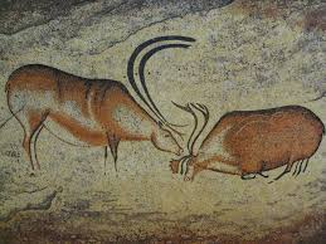
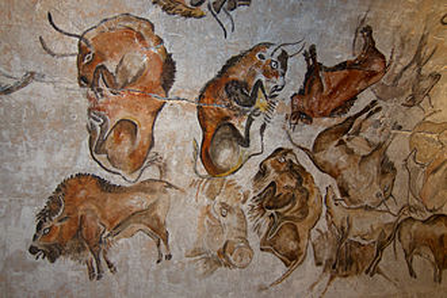
Today I wish to strike kindred with such a caveman, and let us the two descry the other scenes of human existence, and may we relish a warmhearted soup of conviviality, for history, like art and philosophy, is like a balm to my soul. My partner turns out to be an excellent cook, a hunter-gatherer, but also an artist, and he knows how to make good use of the gazelle, the bull and the cow, the deer, and all such creatures for the most utilitarian of purposes.
I am still activated by a "deep-seated stir," a spirit of curiosity has taken grasp of me, and I am willing to come to grips with a caveman, and let us the two compare the ages, and if he is found to be happier than me, then let him instruct me on the source of his happiness. But if he is to be found wretched, lonely and barking all daylong like a dog, then let us come together and perhaps find solace in this mutual conversation across the wordless language of millennia.
The caveman is within me, but I am not constrained by duress or by any such instinctive irrationalities, or protocols of modern society, to either stifle the civil man within me, or to chase away a barbarian with strong leanings for the arts. My main aim is to find a reconciliation, a mutual understanding, between the two: the noble and the barbarian.
Today I wish to strike kindred with such a caveman, and let us the two descry the other scenes of human existence, and may we relish a warmhearted soup of conviviality, for history, like art and philosophy, is like a balm to my soul. My partner turns out to be an excellent cook, a hunter-gatherer, but also an artist, and he knows how to make good use of the gazelle, the bull and the cow, the deer, and all such creatures for the most utilitarian of purposes.
Such animal paintings could be said to be spotless, flawless, accurate. Their well-seasoned meats, when put to roast with the sputtering flames of the all-consuming fire, could fill this cave with a smoky exhilaration of tastiest smells from the ashen ovens of the past. I love it!
Indeed! The hearth of this ancient cave exudes an enchanting sense of liveliest homeliness, and I feel somewhat overwhelmed, as though possessed with a savagery instinct, to give free outlet to an animalistic cacophony of grunting phrases, yes, and nay, intoned in wildest diphthongs of howling glissandos, which, in the candid speech of Mother Nature, may convey an inexplicable hankering homeward return to primitivism.
A boisterous celebration of life could turn this caving-hole into a noisy kitchen, no doubt a mad place from the luxury of modern society, but it also impresses me as a studio for some crazy artist. The cave-canvases are besmirched with strangest hues, some resembling bloody splotches; other substances, assuming the most abstract of conceptions and blotches, are somewhat mottled with yellowish hues, orangish, reddish pigmentation, as drained down from the tissues, sinews of animals' carcasses, or from the vegetative decomposition of organic material.
I fancy to comprehend the prophetic meanings of such meandering hieroglyphs, living entrails from the womb of time, whose formless shapes and dribbling characters could perhaps adumbrate the history of humanity as an endless cycle of recurrent events. The Book of Ages is understood by the caveman. Should I ask him to instruct me on the moral lessons of the past?
Like the ancient tools of an ogre, I also made out sharp knives, but also fine-cutting tapering stones, whose tips and edges could peel the skin smooth and clean. Further in view, lo and behold! the rusty utensils of millennia, pans, kettles, bones, skulls and teeth, still intact, clattered, rang and gnashed with such felicitous vibration of propelling whirrs, verve and joy, that I soon took pleasure to finding myself in the agreeable company of such rustic stuff of primitiveness.
Hoorah! On a cloudy day, I had the rare privilege to be seconded as a scullion under the tutelage of this admirable chef of tastier, roasted vitals and guts, a savage, but a man with a penchant for the culinary art. On one such occasions, I was heartily treated with some daintiest bites of venisons, whose clean delicious mutton, soon cheered my heart for the trophies of a barbarian life.
With tickets in hand, let us now have a riveting jaunt into the Caves of France, and, if possible, let us finally salute our distant comrades with the handshakes of millennia and solidarity.
Indeed! The hearth of this ancient cave exudes an enchanting sense of liveliest homeliness, and I feel somewhat overwhelmed, as though possessed with a savagery instinct, to give free outlet to an animalistic cacophony of grunting phrases, yes, and nay, intoned in wildest diphthongs of howling glissandos, which, in the candid speech of Mother Nature, may convey an inexplicable hankering homeward return to primitivism.
A boisterous celebration of life could turn this caving-hole into a noisy kitchen, no doubt a mad place from the luxury of modern society, but it also impresses me as a studio for some crazy artist. The cave-canvases are besmirched with strangest hues, some resembling bloody splotches; other substances, assuming the most abstract of conceptions and blotches, are somewhat mottled with yellowish hues, orangish, reddish pigmentation, as drained down from the tissues, sinews of animals' carcasses, or from the vegetative decomposition of organic material.
I fancy to comprehend the prophetic meanings of such meandering hieroglyphs, living entrails from the womb of time, whose formless shapes and dribbling characters could perhaps adumbrate the history of humanity as an endless cycle of recurrent events. The Book of Ages is understood by the caveman. Should I ask him to instruct me on the moral lessons of the past?
Like the ancient tools of an ogre, I also made out sharp knives, but also fine-cutting tapering stones, whose tips and edges could peel the skin smooth and clean. Further in view, lo and behold! the rusty utensils of millennia, pans, kettles, bones, skulls and teeth, still intact, clattered, rang and gnashed with such felicitous vibration of propelling whirrs, verve and joy, that I soon took pleasure to finding myself in the agreeable company of such rustic stuff of primitiveness.
Hoorah! On a cloudy day, I had the rare privilege to be seconded as a scullion under the tutelage of this admirable chef of tastier, roasted vitals and guts, a savage, but a man with a penchant for the culinary art. On one such occasions, I was heartily treated with some daintiest bites of venisons, whose clean delicious mutton, soon cheered my heart for the trophies of a barbarian life.
With tickets in hand, let us now have a riveting jaunt into the Caves of France, and, if possible, let us finally salute our distant comrades with the handshakes of millennia and solidarity.
At the basic level of survival, such old mysterious paintings, often engraved in the time-stricken walls of the distant past, may speak volumes on mankind's earliest attempts to laying down the cornerstones of civilization. Or, and in all likelihood, such primitive artworks could be indicative of early human hardships in the caves of isolation, primitivity, and ignorance. They could also warn us of stranded stragglers in the serious battlefield of existence, whose only hope was perhaps to record their awful chronicles in the hard canvas of stonewalls.
What major event could have thus ended their existence?
As bleak as the moral lessons of the past in the unrolling scroll of fate, I may infer the meaning of such ancient paintings as extant remainders that human evolution is not always linear. There are countless pitfalls along the precarious paths of existence. The cave-artists of ancient times, whose sentinels could speak more eloquently than the best book on history, today never cease to amaze me. They are as relevant as the latest news or inventions of modern society, for such extremely ancient paintings, as those found in France, could reconstruct the earliest assembly of humans and their challenges in the logistics of survival.
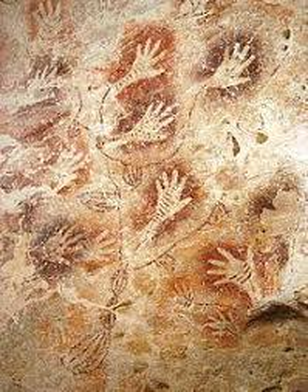
What major event could have thus ended their existence?
As bleak as the moral lessons of the past in the unrolling scroll of fate, I may infer the meaning of such ancient paintings as extant remainders that human evolution is not always linear. There are countless pitfalls along the precarious paths of existence. The cave-artists of ancient times, whose sentinels could speak more eloquently than the best book on history, today never cease to amaze me. They are as relevant as the latest news or inventions of modern society, for such extremely ancient paintings, as those found in France, could reconstruct the earliest assembly of humans and their challenges in the logistics of survival.
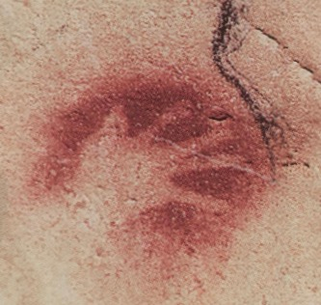
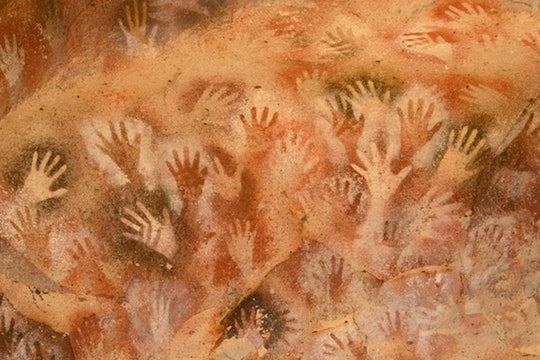
However subjective, when I set my eyes at the creepy aspect of such ancient works of art, I cannot evade an element of apprehension and dread when trying to comprehend the persistent enigma of the ages: what is the true story of the human race. These outreaching hands, as though emerging out of the wall, may continue to defy our understanding.
True! The caves of this world are replete with masterpieces, bearing witness to the mysterious artists of the past, their names lost forever, could claim a preeminent place alongside artists the likes of Phidias, Leonardo da Vinci and Michelangelo, but the formers are doomed to remain in the obligated nights of the past.
Theirs was not an academia based on unerring accuracy of proportion, as those of the Rennaissance Artist, but the caveman of the past possessed a most subjective, I would say, a profounder approach to the universal figments and mysteries that haunt us all: the uncharted territory in the long wanderings of the human race on the surface of the earth. Therefore, lying deep in the unconscious reaches of our collective psyche, there is to be found a veritable treasured-trove of human experiences, memories and knowledge, whose moral lessons, perhaps could help us overcome some of the most frightening threats to human existence: plagues and pestilences.
It is noteworthy that some artworks, as those creepy figurines and goddesses, could be said to encapsulate the psychological tapestry of a world overrun with the haunting figments of fear, isolation and dread.
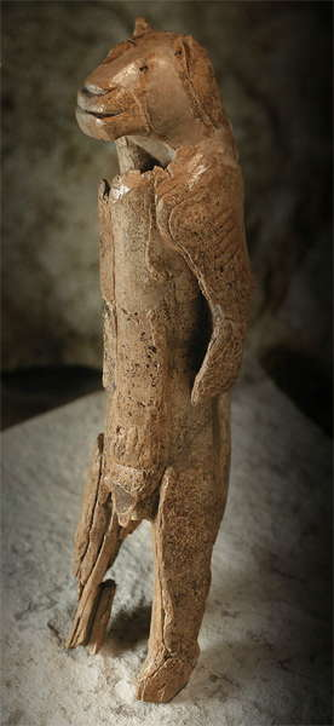
True! The caves of this world are replete with masterpieces, bearing witness to the mysterious artists of the past, their names lost forever, could claim a preeminent place alongside artists the likes of Phidias, Leonardo da Vinci and Michelangelo, but the formers are doomed to remain in the obligated nights of the past.
Theirs was not an academia based on unerring accuracy of proportion, as those of the Rennaissance Artist, but the caveman of the past possessed a most subjective, I would say, a profounder approach to the universal figments and mysteries that haunt us all: the uncharted territory in the long wanderings of the human race on the surface of the earth. Therefore, lying deep in the unconscious reaches of our collective psyche, there is to be found a veritable treasured-trove of human experiences, memories and knowledge, whose moral lessons, perhaps could help us overcome some of the most frightening threats to human existence: plagues and pestilences.
It is noteworthy that some artworks, as those creepy figurines and goddesses, could be said to encapsulate the psychological tapestry of a world overrun with the haunting figments of fear, isolation and dread.
Art, nonetheless, might have had some transformative powers in the worldview and prospect of the lonely ancient artist. Nay, for the cave-artist, so disconnected from the outside world, and long tried in the sequestered quarters of isolation --often punctuated with hypochondriac bouts of mental vacancy, despair and nihilism--- perhaps the cave-dweller (s) were a bevy of survivors at bay, and so they left us this plethora of artworks, whose meanings could perhaps point to a tragic end. An unknown mysterious people still trapped in the caves of the world. This may explain the seeming devilish grotesquery of the caveman's oeuvre, but would you say they don't deserve a place next to Picasso or Van Gough?
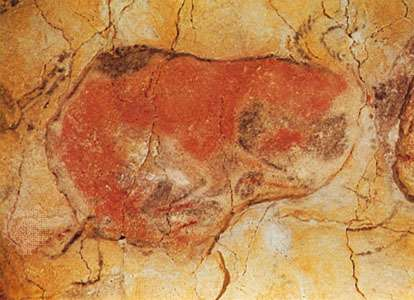
In spite of all these pejorative comments on the ancient people's artistic simplicity, there is a more optimistic assessment to the question of existence through the power of art, and it is, nonetheless, the most justifiable of all human endeavors, nay, it is praised as a form self-expression, even when this human activity does not always obey the principles of objective reality, a polisher culture as conceived by the noblest of the ancient people, especially the Ancient Greeks. After all, there is always an audience for the marvels of the ancient past.
Hence, art is either a lie or an illusion, which, by some happy twist of moral necessity, perhaps an archeological discovery, or a preferred fashion in vogue, could ultimately enjoy a place of respectability and prestige in a world where truth seems to be but a matter of relative perspectives.
Regardless of the epoch, approbation, or snarky criticism, the creative artist could ultimately be compensated with due recognition.
Most importantly, for the isolated artist, whom is the least concerned with worldly success, life's existential challenges could be transformed into blissful moments of aesthetic contemplation and delight. True, as much as we try to understand the ancient artists' motives, their ethos, all we can do is to grope and fumble into a distant world so separated by the missing lacunae of thirty thousand years into the mist of time. Therefore, any answer to such baffling questions could be elicited but on the high-flown wings of wishful conjectures.
A psychological evaluation of such ancient artists' frame of mind may be frowned-upon, laughed-at and forthwith dismissed as a joke, but some would not underestimate the surrounding influences, milieu and clime, when spinning speculations on what is scarcely plausible, or discernible, from the premises of our times. Such theories, " the mental state of the artist, " however useful when applying it to the other fields of human learning and disciplines, do not win my sympathy, but one ought to be open to such scathing criticism.
Thus, so we are told, enervated by the rough conditions of a tough existence, the cave-artist's aesthetics, according to some critics, should be assessed but in conjunction with, or as an expression of "tremendous psychological tension," a mere representational conveyance of conflicts and wars in the struggle of existence.
This may not seem a too preposterous appraisal, but we all know that most artists are said to suffer some form of mental disturbances, mental illnesses, but to degrade the value of artistic merits, or output, based on current social parameters to defining the width and length of human creativeness as the sole patrimony and prerogatives of my contemporaries, is to underestimate the high-pitched intelligence and mental fortitude of the ancient people when coping with the equation of existence. Of course, the cave-people had to fight their shadows in the dark hours of human desperation, fear and dread in the unutterable pages of history.
According to some critics, such ancient artworks could be accessed but as the output of a people gone mad and wild, or as the dilettantism of an uncultivated people scarcely rising above the level of savages. Such was the blinkered worldview of the ancient Greeks when passing judgment upon those tribes living in the hinterlands of barbarism and bestiality.
The caves of the world are filled with the junks of humanity.
Finally, if I were to draw any conclusive opinion on what is the true meaning behind the artworks of such mysterious a people, one would be bound to admit, notwithstanding my perplexity when fronting or deciphering the riddles and conundrums of the past, but as a political manifesto in the struggle of existence, yet written in the oldest language of humanity. However uncanny from the comfort and sybaritism of modern society, such artworks could warn us of the decline and collapse of urban society even in the dawn of history.
* * * * * * * * * * * * * * * * * * * * * * * * * * * *
On the Crisis of Our Times: The Possibility of Contact with An Extraterrestrial Civilization from the Premisses of Our Technological Developments:
Due to din noise and the distraction of our hectic times, inconsistency and desultoriness are faults for which I must constantly ask forgiveness and forbearance. These common symptoms, as those of stress, angst, ambivalence, disturbance, paroxysm, among other psychological perturbations in the conflicting music of our time, may rather point to a larger crisis in the very core of our civilization.
The placid serenity of some animals in the wood, e.g., the frisky squirrel and the blissful birds of Thoreau, unperturbed by any concerns, ennui and brain-racking cavils of the “ghetto-citizen of our civilization,” may impress me as perhaps too naive in the serious struggle of existence, but I am tempted to believe the “rustic peasants of yore” to enjoy a happier existence than the sleep-walker, soulless automaton of our inquiries.
Nevertheless, when assessing the fundamentals of our so-called civilized society, I cannot deny a greater share of happiness among those friends who have found lodging, peace, and a quiet enlightenment in some sequestered spot, cradled by the generous boons of Mother Nature.
A greater spirituality, coupled with a keener sense of vitality, energy, and a kind of healthy intoxication, seems to nourish the soul of the naturalist.
Virtues, potencies, and forces which, for the most part, lie dormant in the automaton of our inquiries, are constantly at work in the womb of Mother Nature.
By neglecting to grant our bodies and minds a greater participation in the natural theaters, the luscious libations and living operations of Mother Nature, we have reduced ourselves to little animalitos — the Lilliputians of Jonathan Swift — with a sickly penchant for the firecrackers and fleeting gadgets of our civilization.
Training ourselves to live amid the distractions of our times is a thankless task. It would demand not mere adaptation, but the birth of a new society, a new milieu, a new mentality — a complete revaluation of the intrinsic values, gifts, and potencies latent in every human being when reared and nursed within settings of the grandest scope.
Every now and then, I have come across skeptical minds who regard humans as not so different from gnats, mosquitoes, fleas, or the roaring drones of summer — ever complaining about the meaning of life.
Many skeptical minds, mostly nourished on materialism, cannot live beyond the realm of rocks, metals, and their stubborn, wired indolence — as if this were the sole mode of existence.
With the staggering explosion of gadgets and other unnecessary electronic luxuries born of our sciences, it has become increasingly difficult to cultivate a genuine congeniality with the unquestionable benefits and boons of Mother Nature.
There are those skeptics — like slimy creatures oozing forth from the experimental labs of biogenesis — who, disappointed with the human race, have chosen to dwell amid swamps, moraines, and moats of fetid water, rarely reaching the Safe Citadel against the advancing army of Nihilo (Nihilism: the belief that there is no meaning in this life).
Other straggled souls — those fatal existentialists nourished on the insidious philosophies of Camus and Sartre — have at last surrendered their most precious spiritual belongings to Nihilo, the god of meaninglessness in our time.
Accordingly, when approaching some post-modern philosophers, I must constantly guard my mind against such drivels and twaddles — the noxious stuff and swill of our post-modern times.
Bacterial thoughts, like anything parasitic and harmful, can be transmitted even through the finest forms of prose and philosophy. And soon the spirit finds itself inundated by a morbid sensation — a chill of desolation, nihilism, competitiveness, and the silent breath of the grave.
If you have found any merit in these humble reflections on the crisis of our civilization, I invite you to peruse the refreshing writings of Henry David Thoreau — especially Walden Pond: Higher Laws.
Perhaps you are already familiar with the refreshing insights of Henri Bergson’s philosophy on consciousness and intelligence.m
Better than many new-age gurus, money-making charlatans, or charismatic evangelists, Bergson’s luminous vision of life — as a mirrored reflection of our higher strivings in the sublime and peaceful realms of existence — stands as a testament to how a truly elevated mind can deliver us from the predatory, pernicious mosquitoes of our times.
Of course, such Debussy-like philosophy would require new ears for a new, supernal music — nay, a pure heart attuned to the serene, pellucid lakes of thought, vitreous and crystalline, as is only possible when we elevate ourselves beyond the lower impulses of the “ghetto-man” and “ghetto-woman” of civilized society.
If you have ever thought yourself to be more than a complicated bundle of biological matter, more than an automaton, more than a mere defective mechanism in the chess game of chance and fate — or perhaps sensed that you are something greater than a post-modern hybrid enslaved in the mechanistic procedures of civilized society — then the path toward renewal and true consciousness still lies open before you.
If you have ever felt yourself to be none of the above, but something more — perhaps divine, intelligent, sentient — then you are awakening to a new revelation of yourself.
These are the first signs that you are no longer content with the Matrix of our times, for your inner self — perhaps all along — has been diligently searching for new thought-materials, new prototypes analogous to the nature of higher essences, airs, minds, and spirits.
You are not alone.
Perhaps there were times when you felt yourself to be something more than a two-legged, bipedal creature feeding on the carrion and carcasses of Darwin’s survival of the fittest.
Perhaps there were times when you felt yourself to be more than just a mammal — a biped of clumsy gait, a mere ridiculous brute making grimaces, winces, and meaningless headways in the struggle of existence.
Have you ever felt like this — even for a fleeting moment? Yes or no?
If you have ever felt yourself to be a greater biological project in the vast laboratories of intelligence, sentience, awareness, and consciousness, then you are — so I hope — ripe and ready for the transcendental philosophy of Henri Bergs
Three blooming virtues can make you stand out as a remarkable person committed to a higher form of existence: diligence, productivity, and probity — virtues Kant himself praised in his Essay on the Different Human Races.
Please, take a moment to imbibe these lofty and insightful thoughts — these revelations and epiphanies — which, if nurtured within, shall bear good fruits of peace and well-being.
The Philosophy of Henri Bergson
https://m.youtube.com/watch?v=ShPPua3HBiE
* * * * * * * * * * * * * * * * * * * * * * * *
On the Possibility of Intelligent Life in The Celestial Shores of the Cosmos:
In this final revision, and in these reflections on the possibility of extraterrestrial life, I have added several provocative thoughts and “nays” within the confines of brackets [ ]. You will find them scattered here and there, like small guiding lanterns, as we embark upon this journey of life — the greatest wonder of all our inquiries.
That aliens and gods may be but reflections of our own psyche brings objective data no less real than the fancy of figments, dreams, and illusions; and if there is any glimmer of hope for resolving the great questions of space, time, and immortality, it must be sought in the phenomena of consciousness and sentience
And if these latter — consciousness and sentience — can exist independently of any biological procedure or decomposition, then we are called to re-embrace ourselves as spiritual entities.
As such, let us ponder the beauty, love, and divinity of a higher universe — a realm replete with essences, souls, and heavenly beings whose joy and beauteous existence remain untouched by the conflicts and clashes that beset this Darwinian world of wars, woes, tears, and injustice.
This is the sad reality for those materialistic atheists who may finally succumb to the dint of reason when confronted with the baffling and mysterious origin of good and evil — believed by many to be merely subjective, even though evil itself, across the long stretches of time, seems to have found bodily manifestation in the warty head of a snake: La Serpienta Antigua
Physically speaking, aggression may appear to be nothing more than a plaything of blind forces and organisms struggling for supremacy; but when we delve deeper into the nature of humankind, we cannot reduce these recalcitrant creatures — Homo sapiens — to the low level of brutish animals, viruses, or bacterial nits endlessly reproducing in staggering quantities upon the surface of the Earth.
No doubt, some people are said to be beautiful, good-hearted citizens — ideal for a better world. And if we are to make any careful assumption about human nature, there are indeed many remarkable cases of extraordinary perfection, elevation, and probity. At times, here and there, one may come across extraordinary individuals — whether dear children or venerable elders — gifted with astonishing degrees of saintliness, moral integrity, and intelligence. These radiant souls point to higher types, projects, and marvels within the surprising family tree of Homo sapiens.
The vices typical of the current development of our beloved Homo sapiens — greed, pride, covetousness, and the like — may be deemed no less savage than the sordid behavior, waggeries, and waggishness of chimpanzees and the all-grubbing baboons running amok in a zoo: barbarism, viz., the Revolt of the Masses of my admirable José Ortega y Gasset.
Though there is much ground for classifying a large part of mankind within the demoting brackets of pernicious, “predatory entities,” there is nevertheless a great deal of good in humanity — beautiful qualities that could justify its earthly existence as part of a larger, meaningful, and grand cosmic plan. Yet one must wonder: if these nits and broods were ever allowed to propagate beyond the ecosystems and habitations of our planet Earth, what other calamities might humankind bring to the celestial shores of pristine exoplanets?
Meanwhile, their kind must be restrained from further harm. It is only through the agency of either Mother Nature or Providence that a decisive and universal change in the unpalatable history of humankind — however rife with wars and unspeakable sufferings — may finally usher in a new epoch of greater peace, love, fraternity, and understanding.
Perhaps such future humanities will hold the tickets to interstellar travel, and the seed of a new humankind will flower, bloom, and blossom in the most beautiful, lush, and serene worlds conceivable — new celestial realms where water, mild temperatures, and luscious oxygen might welcome the celebration of life’s verve, free from the stings of snakes, fleas, thistles, and sufferings.
That said, and following the rigor and inquiries of a philosophic mind in the objective assessment of the visible world around me, my conclusion is that there is neither verifiable nor evidential ground to assume that intelligent, physical aliens from outer space are presently meddling with the crazy affairs of our Homo homini lupus.
* * * * * * * * * * * * * * * * * * * * * * * *
Midsummer of the Year 2016:
My mind, enervated by a wave of heat and exhaustion, could not so readily correct the obscurity of certain passages on the keyboard of clarity and lucidity. I had to rework this essay, replete as it was with wrong dictions, hackneyed phrases, and redundancies. Nevertheless, dear reader, bear with me as we once again touch upon the question of extraterrestrial life — hostile or benevolent?
In this latter revision, I have included links to additional references, and my thoughts now dare to strike kindred with the works of serious authors who have grappled with the uncanny and controversial origins of the human species.
So as not to wound the religious feelings and convictions of some of my beloved readers — some of them Christian, others Jewish — I felt bound to find corroboration in the sacred literature of the Bible, a venerable and reliable source often quoted by serious authors when alluding to extraterrestrial contact, spirits, demons, or angelic hosts from outer space (see Ezekiel, Chapter 1, Old Testament).
As I perused my own thoughts and writings on the subject of extraterrestrial contact, I was surprised to find that my ideas bore little conflict with the canon of the New Testament. This duality between the children of light and of darkness became all the more meaningful when I admitted the possibility of higher powers and dominions as the principal agents behind much of humankind’s suffering (Ephesians 6:11–23; Revelation 12:4).
Therefore, while grappling with the facts surrounding the possibility of extraterrestrial life, I felt bound to reexamine the wise counsels of those venerable prophets, holy men, and women who may have possessed a clearer understanding of this millennial dichotomy between the forces of good and evil.
However respectful of religious institutions I may be, I could not win other friends by supporting my insights and opinions on the staff of faith alone. Philosophy, Sophia, and the Muse have gently led me to seek wisdom, God, and true congeniality in the holy shrines of Mother Nature.
This essay is a continuation of the ever-controversial issue of extraterrestrial life, and of how any respectable stance on the matter must contend with the lack of conclusive, tangible proof in the solemn verdicts of both science and archaeology.
Nevertheless, philosophically speaking, the most unexplored territory in the search for intelligent life may not lie in distant galaxies or fossilized ruins, but in the very phenomena of consciousness and sentience themselves — those hidden dimensions of being where intelligence may manifest long before it becomes visible to telescopes or instruments.
Unable to draw a definitive link between the shimmering sparks of consciousness and the baffling operations of the brain, we are left with the hope that while energy may die out in one form, it might continue to exist beyond the decomposition of our physical body.
In the following essay — a seminal analysis of life as found here on Earth and perhaps elsewhere in outer space — I dare to examine the question of “aliens’ periodic visitations” while perusing the wonders and riddles of our own planet’s ecosystems, and the complex biological dynamics shaped over deep time in the ever-blasting laboratories of Mother Nature.
I cannot turn my gaze outward, nor search elsewhere among the distant stars, without first undertaking a careful inquiry into those causes and organisms — oftentimes hostile and predatory — which seem fatally bent upon aggression and the ruin of their own dwelling place.
Of all the creatures that roam the Earth, it is humankind alone that is known not merely for predation, but for a darker and more deliberate tendency: for unlike the lion, the snake, or the ponderous hippopotamus, the human race seems capable of taking a perverse delight in the devastating power of fire, and in the most revolting alterations of its own natural dwelling.
Therefore, after years of pondering the writings of Henry David Thoreau, I felt bound to praise those learned seers, poets, and philosophers who, time and again, have lifted their voices in warning against the obnoxious effects of a civilization grown unnatural — a civilization that steadily reduces every noble aspect of human life to mechanistic, materialistic, and pragmatic procedures, and to the dreary confinements of head-scratching reductionism.
The argument against Homo sapiens’ technological and destructive prowess may likewise cast a certain light upon those mysterious reasons — insoluble, perhaps, to the modern mind — that seem to account for humankind’s long disconnection and isolation from the greater cosmos. For nearly two millennia, the heavens have remained silent; and yet, in ages long past, the ancients are said to have communed with extraterrestrial deities, angels, demigods, or other enigmatic beings who descended from the skies.
Were these celestial visitants but the products — or perhaps the projections — of a collective psyche, woven from the fears, hopes, and longings of ancient peoples?
Such head-scratching tales may well have been exaggerated through the ingenious and well-attested tendencies of cult-founders, who, giving free vent to the mind’s resourceful imagination and its wishful longings, launched mankind upon one of the most fascinating voyages of all.
Nevertheless, there are those who hold, with quiet conviction, that these gods or angels were not mere phantoms of the mind, but technologically advanced beings who once came to us from the twinkling stars.
As we contemplate the advancing technological prowess of our civilization, it seems not implausible to surmise that we shall soon reach those twinkling stars, and then perhaps we shall discover whether these so-called gods or angels, borne upon spaceships, were but childish tales for a humanity still slumbering in the manger of religion, ignorance, and primitiveness.
Unlike the gods of yore, whose divine powers were said to be bound within the sacred limits of Mother Nature, the gravest danger posed by Homo sapiens lies not merely in its reckless technological prowess, but in the terrifying likelihood that its incorrigible tinkering with the forces of nature — even with the subtle immensities of quantum physics — may yet prove its own undoing and ruin.
Not content with the lush and splendid vistas of our own planet Earth, we are ever in search of some fairer paradise elsewhere; and it little occurs to me that, perhaps — or perchance — this is indeed “the best of all possible worlds” for my dear Homo sapiens, to borrow the very train of thought of my admirable Gottfried Leibniz.
Moreover, should these wicked critters ever succeed in traversing the outer limits of our solar system, one may well wonder what fresh troubles and misfortunes might be carried into the Elysian vistas of other splendid worlds.
Thankfully, the enormous distances that separate certain hostile organisms, when contemplated from a cosmic perspective, may serve as natural boundaries to the mystery of iniquity — that essentially predatory principle so rife upon this planet Earth. For were it otherwise, in the long stretches of time, what woes and calamities might ensue under the unchecked corrosion of intelligence, spreading its troubles to the outer limits of space?
Accordingly, I dare keep a watchful eye upon the essentially combative nature of our human species, which may yet prove capable of carrying its damages and destructions into the distant celestial shores of our own solar system.
Highly intelligent, yet essentially caustic and corrosive like fossil fuel, humankind continues to multiply like the sordid Yahoos of Jonathan Swift, to the detriment of our planet’s most delicate efforts in the phenomena of life and biogenesis. Such a spectacle would argue against the notion that the human species — however philanthropic when stirred by the innocent smile of an adorable child — is essentially good and harmoniously integral to the universe, and that it ought to be permitted to reproduce upon the pristine surfaces of other worlds.
But unlike Bertrand Russell, in his classic Why I Am Not a Christian, I do not regard the human race as “inessential or useless” in the potential colonization of other planets. It may be that our brief earthly existence forms part of some greater germination of the human genus-seed — or genome — intended as a basis for intelligent life throughout the universe. And yet, I must confess, I hold this inference in the deepest doubt.
If there are indeed intelligent extraterrestrials observing us in this our inexorable race to contaminate the Earth, some finer minds may well wonder at the seeming indifference and tardiness of such furtive entities to intervene — and, by heaven’s sake, perhaps to put an end to the gravest afflictions of humankind: hunger, systemic collapse, and the ever-present terror of nuclear annihilation from the very surface of the Earth.
—-Where are the gods?
On the contrary, we are told by ufologists and other enthusiasts that these supposed aliens would simply expect us to learn from our own bitter and unpalatable mistakes; that a cosmic confederacy of planetary civilizations has, by some tacit accord, resolved not to meddle in the frail and tumultuous affairs of our human world.
And so they would simply stand by, indifferent onlookers, while we continue, unremittingly, to pollute the seas and rivers with the wastes and refuse of human civilization.
The Silence of the Gods
The only reasonable argument for their apparent refusal — or objection — to any open dialogue with our species lies perhaps in our own low ethical principles, no less savage than barbarians running amok upon the surface of the Earth; or in our seeming primitiveness, no better than sordid brutes. Greed, filth, ignorance, mendacity, bigotry, and religious fanaticism render us incapable of accepting a new account of the origin of life on Earth — one that might unsettle the fragile foundations of our creeds.
It has also been reported that such “unparalleled encounters with extraterrestrials” would unleash worldwide panic, shaking the very pillars of traditional authority and religious belief. The consequences, it is said, might prove far-reaching — even to the solvency of our banking systems — for both gain and faith would wane, and the in-comings that so profitably fill the coffers of our modern megachurches would dwindle to a trickle.
Moreover, who can say whether humankind is, as yet, prepared to embrace the unsettling fact that we are not alone in this vast universe? Such a revelation might well precipitate our species into a perilous loss of moral compass; in other words, chaos and rampant disbelief could follow, as traditional religious systems — those long-standing metaphysical holders and guardians of social order — prove no longer capable of restraining the restive herds. Thus might unfold a revolt of the masses, disillusioned at last before the ever-vexing question of meaning upon this ancient Earth.
Nay, it is quite possible that open contact with a superior civilization could unsettle — if not altogether ignite — the sensitive and explosive niter of human society; for humankind, rightly called a social animal, may then resort to unrest, vandalism, and the desecration of its most beloved sacred institutions and edifices.
* * * * * * * * * * * * * * * * * * * * * * * * *
So much, then, for long tales. Most recently, our telescopes have detected curious celestial objects — comets or asteroids, perhaps — appearing as potential visitors or probes from outer space: 3i/Atlas and ʻOumuamua. And it seems that the antiquated “chariots of the gods,” despite the obvious inadequacy of such fuel- or gas-propelled chugging celestial vehicles (the so-called Vimanas of Erich von Däniken), remain curiously in vogue.
And so, my dear friends, just as the peasants of yore in medieval times, we too are wont to project our current psychic developments — our prevailing zeitgeist — upon every fancy of speculative conjecture. The far reaches of the cosmos offer, in turn, a richly dappled canvas, no less vivid than the most abstract artworks, upon which the most outlandish theories may be concocted or hatched in the ingenious imagination of our scientists.
But as Arthur Schopenhauer and Goethe have rightly observed, errors and fallacies — like daunting blades of grass, furze, lianas, and creeping vines entwined about the feet of every seeker — may persist for ages, treacherously binding themselves to the fancies of established academia. To uproot such “scientific dogmas” is to shake the very behemoth of our time.
Such a scientific collapse would render obsolete a staggering number of best-selling books — the Big Bang spectacle of the heavens, born of unfettered human imagination and sustained by head-scratching yet plausible conjectures — all projected onto the star-studded canvas of an abstract artist: the ever-expanding cosmos.
The James Webb Space Telescope daily confirms my point: that human beings remain profoundly subjective in their interpretations of cosmic phenomena — no less mystified than they were three thousand years ago. For ours is a well-known proclivity to project the motley tapestry of our psyches onto the far reaches of “scientific speculation,” deeming it perhaps more reliable than Theogony, the ancient cosmogony of Hesiod.
Nevertheless, I must confess a sense of relief — a very happy moment indeed, a secret delight — upon learning that the universe may have had an origin other than the one currently taught by astrophysicists with their penchant for Big Bangs and nihilism.
Of course, I am not denying the veracity of such theories, but I would rather embrace the Cosmogony of Hesiod, or the Cosmology of the Book of Genesis, as perhaps proffering a more significant place to humanity in the grand scheme of things.
* * * * * * * * * * * * * * * * * * * * * * * * * *
Contacts with Aliens:
Lack of communication has not always been a hindrance to the gradual development of our species; for highly developed civilizations — such as those of the mysterious Sumerians, the Ancient Romans, and the Chinese — were able to thrive and flourish independently of one another. Yet in many accounts, these so-called “visitors from outer space” are said to have offered indecipherable solutions and technological advances which, for the most part, can neither be decoded nor understood by our earthly scientists.
(Please, read this essay in your placid hours of leisure, and forgive those incongruous passages which may suffer from unwitting prolixity or self-indulgent twaddle in the face of the incomprehensible phenomenon of the UFO.)
In the last analysis, the topic cannot be discussed without a certain enthusiasm for the plausibility of extraterrestrial life; yet the force of evidence and facts remains so tenuous, so flimsy, that I am often inclined to treat the subject as little more than the vaporous fancy of metaphysics, art, science fiction, morphology, and biology — the scribblings of a poorly informed witness. Countless books have been written on the matter, yet as Carl Sagan warned us:
"Extraordinary truths would require extraordinary evidence."
As perceived by our robotic probes surveying distant worlds, countless planets reveal surfaces that are dismal, barren, and hellish. And if we are to draw any inference from this grim reality — and from the very struggle of life upon our own Earth — existence elsewhere is likely no less a battlefield for the survival of the fittest, nor any gentler in its sufferings for sentient beings.
From dangerous bacteria, viruses, and all manner of parasitic entities that feed upon the marrow and blood of other species, one may reasonably infer that the vast cosmos envisioned by Stephen Hawking could be teeming with bacterial life.
But what kind of life is there to be found in outer space?
Like the building blocks of organic matter on Earth, it is believed that organisms from distant worlds may share with us the same basic molecular structure — essential to the performance of motion itself. Rightly so, as Aristotle affirmed, life is indistinguishable from movement.
Biological dynamics and life are analogous to the basic principles of existence and activity, for few organisms are said to exist in a state of inertia alone; and even those sluggish ones appear to exert themselves, if only to secure a wider scope of movement and spatial action in the grand emancipation of life.
The conquest of the outer limits of space seems to be a connatural urge; for even among the vegetal and animal kingdoms, the primary motive of life is not merely to eke out its existence for transient needs, but to reach for that which may enhance and elevate its condition, offering a timely alleviation to the dissonant equation of existence. In many cases, this quest for assurance of life impels us to seek, elsewhere, the possibility of a new horizon upon the celestial shores of the cosmos.
In the struggle for existence, the biological brushstrokes of fungus, bacteria, yeast, mold, mushroom, and their kind have left their indelible marks upon every corner of the globe.
Thus, so clearly, Mother Nature seems to point to this irrefutable fact: that complex life-forms may have first arisen from simpler ones. And this insightful view leads us to further speculate — nay, to admit — that higher forms of existence have not yet found their culmination in the creation of humankind.
Homo sapiens, I may dare speculate, is not the crowning achievement of Mother Nature. We may boast of possessing a “representational apparatus,” a proud “Here I stand as thy witness to the marvels of the universe,” claiming an integral place in the grand scheme of things. Yet I cannot be certain that there are not, as yet, surprises waiting to be discovered in the biological mysteries of consciousness and sentience.
The mysterious and uncharted expanses of the seas may well be teeming with self-aware entities, blissfully existing with little alteration to their ancient habitats.
And do we not, we human beings, trace our own biogenesis to the profound waters of creation?
Of course, humans — unlike other organic phenomena, which require no contest of millions of spermatozoa vying for the fertilization of a single egg — cannot simply emerge from the scummy froth of organic matter found in many a damp recess of the Earth. Yet we know well that the seed of life, at least for certain living organisms, may have oozed forth from a primeval hotchpotch, an organic soup composed of water, amino acids, heat, and other residues borne to our planet by the conveyance of meteorites or other cosmic purveyors.
If there is any truth to the possibility of complex organisms existing in outer space — living things such as we find here on Earth — then it must likewise be true that such creatures would subsist at the expense of other organic matter or biological wastes.
That human beings sprang forth and evolved from a primordial seminal genesis of complex organic compounds is a theory neither preposterous nor laughable. Yet it is also held by some that alterations to the first prototypes may have been wrought by some older, unknown species — gods, Elohim, or Nephilim (peruse Genesis, Chapter 2). This view, I must note, is shared by certain Christian friends.
As much as I have pondered this genetic-engineering theory, the sheer complexity of our physical bodies has led me to infer that chance alone could scarcely account for certain performing features of the human frame.
However defective in some functions and vulnerable to bacterial infections, the seemingly superfluous appendages of the body — eyelashes, nails, hair, and the like — may point to utilitarian purposes rather than to the mere fancy of aesthetic predilection in the mating or coupling drives of different species.
But I am inclined to believe that aesthetic considerations — as well as those advantageous to the minimization of pain and the perpetuation of life with minimal nuisance — may have required a measure of purposely designed engineering in the present anatomical form of the human body.
As we retreat more and more from the roughness of the woods to the lax comforts of urban society, these once advantageous appendages may appear unnecessary, even superfluous. Yet the human race, as observed by my admirable Henry D. Thoreau, was designed to exist in conjunction — nay, in conformity — with a far greater community of other sentient entities.
Perhaps we are approaching the omega point — that mysterious threshold at which we may finally set ourselves free from the limits imposed by Mother Nature. And when that time comes, our physical bodies may evolve into creatures more akin to hairless entities, not unlike the extraterrestrials we so often imagine.
Accordingly, “Aliens” — a misnomer from the perspective of a larger cosmic confederacy and fraternity — are, in some accounts, but former members of bygone civilizations; that is to say, technologically advanced peoples who have already mastered the riddles of space, time, gravity, and mortality.
As implausible as this may seem at first glance, the elongated skulls of certain ancient Egyptians may hint at the possibility of a thorough mastery of the higher faculties of mind — sentience, consciousness, or even a Supra-Consciousness capable of resolving the riddles of time and space travel. Such Supra-Conscious Entities, like others of their kind, might still be living somewhere in the sequestered enclaves of our old home planet, Earth.
These are, perhaps, very outlandish theories; yet Dr. Ferdinand Ossendowski, in his magnum opus Beasts, Men and Gods (1922), speaks of strange people — denizens from the dawn of history — said to dwell quietly within the capacious enclaves of our planet’s inner expanses. This hidden realm, known as the Kingdom of Agharti (or Agharta), is believed to hold the “Mothers of Dr. Faust” (Goethe, Part II), brandishing the keys to the mysteries of predawn civilizations.
Accordingly, some ancient peoples may not have vanished altogether; they may simply have transcended the limits of time and space through a complete mastery of themselves. Such mysterious entities might be living among us incognito, so to speak — passing as ordinary citizens of our world — yet perhaps, upon closer inspection, they are the night-watchers of our civilization.
That such earthly “aliens,” whether demons or angels, as evinced in the repugnant morphology of certain mummies lying in the sarcophagi of ancient Egypt, might have an interest in assisting our petroleum civilization to reach a higher level of development in the equation of life, would not surprise me in the least. Yet as a philosopher, I am scarcely persuaded to believe — much less to admit — such aliens, these strangers of the night, as the ideal angels of our inquiries.
Concerning the Physical Disparities and Chromatic Intelligence of the Human Race
My personal view is that human beings — however frail, and so easily subject to putrefaction and decay — are the outcome of past genetic manipulations, or selective breeding, carried out in the tumultuous history of earlier civilizations.
It does not take a very high intelligence to speculate that the Ancient Greeks — whose brilliance, love of symmetrical beauty, orderliness, and philosophy remain the subjects of uninterrupted admiration — were perhaps an adumbration, however short-lived, of Mother Nature’s grander projects in fruition. These wondrous enterprises, marvelous prototypes in their incipient phase, may yet find new expression with the advent of Artificial Intelligence: the reconstruction of bygone eras and peoples through the marvels of this unprecedented technology.
If there is any true marvel in the advent of Artificial Intelligence, it is the promise of superior human archetypes — the luminous meeting point between the divine and the mortal — through its agency, to enhance the quality of life across our planet. Let us, then, free ourselves from any burdensome, tedious chores and unnecessary drudgeries, and turn instead to the higher pleasures of the soul; and, like the Ancient Greeks, let us celebrate the fireworks of the spirit!
* * * * * * * * * * * * * * * * * * * * * * * * *
Our present human species, Homo sapiens, is, in all likelihood, the outcome of ancient interbreeding with slightly divergent types of the early aggressive primates — hunter-gatherers, Neanderthals, and other apelike creatures — whose rudimentary tools and barbed stone weapons are still scattered across the globe.
These latter primates may have interbred with highly developed types — X, so to speak — giving rise to certain remarkable branches of Homo sapiens, such as those highly intelligent and now extinct peoples of ancient Egypt and Sume
Homo sapiens may well be the outcome of genetic engineering, yet our progenitors were not necessarily fashioned after any extant type of the human race.
In this respect, I may respectfully disagree with Immanuel Kant (Of the Different Human Races) who assumed that the variations of the original human kind — the genus — were due solely to attendant circumstances of milieu, latitude, and clime. According to his view, these peoples, over time, became distinct races within the family of humanity. The different races of humankind, for Kant, are therefore but varieties and variations of one and the same original genus or prototype.
Nevertheless, there are those who believe that the intricate design of the human body cannot be ascribed to purposeless, blind circumstances or to the fickle chances of fate in the laboratory of Mother Nature. Predatory eyes with three-dimensional lenses, highly sensitive nostrils, supple limbs, all-clutching fingers, a delicately tuned spinal cord, vital glands, a cerebral apparatus for gathering and processing data, and a complex system of drainage and secretion — all these suggest, to some minds, a design too subtle to be the mere offspring of accident.
However well equipped with an immune system to ward off viruses and disease, the organs of the human body remain vulnerable to swift deterioration.
Nevertheless, our human species — however capable of outliving many others — may yet prove physically vulnerable to infection, even feeble when compared with the protective coverings of certain animals, with their hard, shaggy skins and rough-textured scaliness. And when it comes to the remarkable audacity, suppleness, and tenacity of a snake set upon its prey, humans are not always the most adept at outwitting the ubiquitous presence of night-roaming rodents, vermin, and rats galore — those mischievous entities hell-bent on the total contamination and pollution of humanity’s grandest achievement: the state machine, civilization.
Humans may not have been vouchsafed horns, fangs, feelers, or claws; yet ingenuity has furnished them with weapons no less lethal than those of the shark, the tiger, or the asp.
But when deprived of technology and proper sanitation, and thereby left exposed to contamination, even a mere mosquito could bring human existence to its knees
A widespread epidemic may be borne by those fiendish insects whose sole delight is to feast upon the blood of the herd — my dear humanity.
At any rate, malevolent entities — the likes of bedbugs, mites, lice, fleas, and other devilish biological things — continue to proliferate their kind, lagging not a whit behind those prolific tropical species resilient to the inhospitalities of Mother Nature.
That said, few species have proved as adaptable to varied milieus as those bipeds under our investigati
That such two-legged walking animals might have required the intervention of intelligent genetic engineering would certainly presuppose the possibility of forefathers, progenitors, sires, or gods — an opinion not only shared by religious believers but also by Alienists; and even staunch atheists may, in their own way, welcome the notion of “intelligent interventions” in the history of Homo sapiens.
Due to the rapid proliferation of humans across the globe, countless species have been wiped from the surface of the Earth. Yet our species, Homo sapiens, remains resilient, indomitable, ingenious, and indefatigably curious — forever concocting the strangest alterations and head-racking experimentations, often resulting in monstrous hybrids and regrettable violations of the laws of natur
As observed by the German philosopher Arthur Schopenhauer, every living organism — if fashioned from the pain-reactive, sensitive material of complex organic concoction, as found in most predatory entities — must, of necessity, be spurred to movement, often aggressively, and even bent on attack, thereby securing its existence through the sustenance of other living things. Such entities, in turn, may themselves be contaminated or exterminated, as is presently happening to many species upon this planet Earth.
* * * * * * * * * * * * * * * * * * * * * * * *
Conflicts and clashes are the primary moving causes in the emancipation of any living organism, and every budding endeavor is impelled by the restless mechanism of need and aggression in the reaffirmation of existence.
This is a fact of life.
If there is a kernel of truth in the possibility of complex organisms developing in the far reaches of the cosmos, then it follows that they too must subsist at the expense of other organisms.
In many instances, predatory entities — as dangerous as the rapacious hyena, the flea, the indomitable bedbug, or the pestering gnat that feeds on the blood of cattle — are often compelled to migrate elsewhere in search of new sources of energy and sustenance.
It is therefore very tempting to foresee future invasions by hostile, carnivorous entities feeding upon the sinews, tissues, and membranes of species not unlike our own.
There was once a philosopher who believed that human beings were the preferred muttons of certain extraterrestrials. Of course, our conceptions of such beings — however fashioned in the reflection and semblance of our own physical characteristics — may not necessarily conform to the forms of bacteria, or to the strangest and most unaccountable phenomena drifting in from outer space.
Dangerous, degenerate, and decaying nomadic entities from outer space — intelligent, yet teetering on the brink of extinction — may have been visiting this planet for aeons, albeit clandestinely. These carnivorous beings, desperate to prolong their existence, may have found here, upon this Earth, a vast supply of edible human flesh or, in the most felicitous of encounters, an abundant field of organic matter which they require as much as we require fats and carbohydrates for our own sustenance.
Organic material is the product of striking natural coincidences; more precious than gold or silver, it requires fertile soil and a propitious clime — conditions favorable to the development of life-forms.
Therefore, it is plausible to assume that other intelligent organic entities, journeying across long sidereal distances, might well pause upon this Earth in search of food.
For if Earth, by a singular chain of fortunate conditions, has become a reservoir of rich organic matter, then it is only natural to imagine that such voyaging entities might regard this planet not as a realm of wonder, but as a granary — a living storehouse of nutrients and flesh.
This view is shared by some modern philosophers who correlate reports of alien visitations to Earth not merely with the narrow locality of individual witnesses, but with the global reach of modern civilization itself, where the news of such encounters could encircle the world in a matter of hours.
By the same train of thought, it has been observed that during periods of great population expansion — such as those of ancient Egypt, Sumer, and the vast indigenous civilizations of pre-colonial America — reports of UFO sightings appear to have increased exponentially.
And who are these gods who come from outer space?
In times of widespread media and vast populations, localized reports of alien visitations swiftly become universal phenomena, compelling us to wonder whether such extraterrestrial wayfarers might be no more to humanity than mosquitoes, fleas, or gnats are to the cattle of the field.
The correlations and striking coincidences are simply too numerous to dismiss alien visitations as mere analogues of earthly species migrating in response to dearth and climatic change.
This is common sense. The butcher of our lives (1 Peter 5:8) meanwhile remains hidden, for perhaps we are, like innocent sheep without a shepherd, a lost species — vulnerable hybrids without shelter or protection from the true dangers and rapacious ghouls of this world — and may well end up destroyed by the recurrent forays of other living organisms.
This is indeed a scenario not only frightful, but tragic — especially for those who have long believed the heavens to be teeming with benevolent messengers bringing good tidings to the human race.
The backyard of history is strewn with terrible truths — for those who have eyes to see and ears to hear.
Logic and reason would lead us to surmise this unsettling possibility: that the justification for the burdensome proliferation of the human race is not unlike the propagation of squirrels and other denizens in the slaughterhouse of survival. The difference, perhaps, lies in a larger utilitarian purpose; and if we are bold enough to admit these conclusions as plausible, then we are, in the last analysis, little more than a vast storehouse of edible organic matter — sustenance for cannibalistic aliens on the verge of extinction.
* * * * * * * * * * ^ * * * * * * * * * * * * * * *
On the Possibility of Electric Rattling Snakes Spewing Fire
As we have already invented the drone — that near-ground, flying, killing machine — it is only a matter of time before humankind discovers a remarkably malleable substance: resilient, self-moving through flexible joints, tendons, membranes, and supple limbs, yet bearing the endurance and resisting strength of metal.
Soon we shall have rattling electric serpents crawling and sliding through the crevices of subterranean passages.
These ugly things were already foreseen by Goethe in Faust Part II — those serpentine engines of human ambition, slithering from the forge of restless minds.
We all struggle with the great equation of life — that restless balance between survival, meaning, and the unyielding forces that shape our existence.
. I have always viewed life much as Darwin and Schopenhauer did — through the lens of struggle, instinct, and the inescapable tragedies of existence. The only difference is that I believe in the God of Spinoza and Einstein — perhaps even in the gods imagined by Erich von Däniken.
Of course, I accept the God of the New Testament as merciful and loving. Yet down here on Earth, the marks — the Mark of the Beast, 666 — and the hideous spoors of the beast are spread all over this old planet.
La Bestia es una realidad de la existencia — no un mito, sino una sombra que acompaña al hombre desde el amanecer de los tiempos.
Today, ancient Egypt stands as little more than the burial ground of past civilizations. And I do not discard the possibility of periodic — albeit disastrous — contacts with extraterrestrial intelligences whose ethics are not always aligned with the preservation of humankind.
Individually, human beings are wonderful — even beautiful. But collectively, the human race may prove to be little more than an army of combatants, for like a swarm of contrary ants, they would soon devour one another.
The struggle is real. It is unjust that there are so many ways to destroy a human being. Highly intelligent souls can attest to this battlefield in the inner reaches of the mind — where only the most able learn to guard the fragile fabrics of their inner fortress against unpredictable ass
What is truly terrifying is that whoever possesses your soul thereby gains authority over your thoughts, your emotions, and your decisions.
You are but slaves building pyramids for hidden oligarchs — mysterious powers enthroned in the upper spheres of society — whose will can shape the conditions of your very existence and sustenance.
Most recently, I watched a terrifying film — Alien vs. Predator. Watch this movie, and test your mettle in the struggle for existence in the vast, indifferent universe of Stephen Hawking. It is, in its own strange way, a continuation of Schopenhauer’s philosophy: the will to survive laid bare in its most brutal form.
* * * * * * * * * * * * * * * * * * * * * * * * * *
Canadian Government Admits UFO's & Aliens Exist -
https://m.youtube.com/watch?v=5N3y0goXPZw
Religious institutions that fail to address the possibility of life on other worlds may fall behind the ever-expanding horizons of humankind as it approaches the celestial shores of Divinity.
Unfortunately, the baffling mysteries surrounding the origin of our species are no less intriguing than the comforting belief — at least for some traditionalist Christians — that our planet Earth is, perhaps, the only habitable world in our solar system.
But as we peer through the spectacular window of cosmic grandeur, logic and philosophy lend weight to the plausible possibility that life is a common by-product of water, heat, and amino acids.
The innocent child, once cradled and nursed in the manger of former ages, is now coming of age — ready to embark upon another awe-inspiring chapter in the chronicles of intelligent life beyond our beautiful planet Earth.
As we gather the lessons of millennia, it seems probable that, from time to time, there is a separation between the wheat and the chaff — a gathering of the finest gleanings and seeds in the great harvest of humanity (Matthew 24).
Logically, if we are indeed being observed by superior, super-intelligent entities — as affirmed by men and women of the highest respectability and office, who have warned of the imminent dangers facing our civilization — then it is conceivable that there could be a great evacuation, a kind of rapture, in which a select few might be spared from a coming destruction.
Veiled in the fables of religion or myth, it seems probable that our civilization — burdened with mind-boggling debts now reaching thirty-six trillion — may ultimately have to be salvaged and assisted by an outside power no less miraculous than the God of Moses in ancient Egypt.
But are we mature enough to encounter this Power without the veil of religious mystification — to boldly proclaim Him as accompanied by mysterious entities, resembling angels or aliens, descending in lightning celestial vehicles?
Whether you are a Christian, an agnostic, or an atheist, we may all agree on this: the planet Earth is, indeed, a miracle — a masterpiece of striking and delicate coincidences.
Concerning Modern Civilization
While modern civilized man may praise the great advantage and luxury of owning an automobile, there are still lovely places in this world that make us all the more grateful for the simple gift of legs and limbs.
Naturally, the inner urge to walk during the early hours of morning or evening — which are often propitious due to milder weather — may be one of the healthiest activities known to us, and its benefits can scarcely be overstated.
http://m.casadellibro.com/libro-el-arte-de-caminar-tras-los-pasos-de-henry-d-thoreau-walking-un-manifiesto-inspirador/9788493683245/1614086
Of course, few would find joy in walking under the scorching heat of a sweltering, Hades-like day, when such a stroll could feel more like punishment than pleasure.
People who come from tropical climes — especially those who have endured the stings of mosquitoes, parasitic nits, intestinal worms, and barren lands — often find that, upon setting foot in New York City, the advantage of having a car can be likened to other luxuries of modern civilization: a cell phone, a computer, a television, a DVD player, and the many gadgets that ease the burdens of existence in a modern, urban world.
Few would deny the benefits of having a cellphone or a computer, and fewer still would dispute the fact that an automobile is far preferable to a horse, a mule, or a donkey.
That said, civilized Homo sapiens — however clever these bipeds may be — cannot truly be said to be healthier than those sordid brutes swinging through the trees and forever devouring bananas, rancid meat, and the occasional sausage.
The question remains whether Homo sapiens — as we know them, two-legged earthly entities and no less aliens to the woods than the beaver, the ermine, or the squirrel — were ever naturally designed to live in environments where their bodies might suffer less from obesity, mental atrophy, retardation, and degradation.
Another argument against civilized Homo sapiens lies in the irrefutable evidence of scummy excesses, refuse, and rotting organic waste that besmirch nearly every inch of our habitats and ecosystems.
Much has been done to stave off the invasion of a repugnant swarm of denizens creeping up from the subterranean passages of New York City.
According to the Department of Health & Mental Hygiene, the war against vermin and the rat-feces infesting our expired carrion and carcasses could ultimately give rise to another brood of humanity — the People of the Abyss, as forewarned by Jack London.
The predicaments of modern Homo sapiens are not limited to an unnatural diet, poorly conceived habitats, and perilous incubation techniques. Even the staggering density of their own reproduction, at such close quarters, could unleash strange diseases, virulent plagues, and hellish broods of prodigious proliferation.
New designs of the human type may one day emerge, for many species have already been lost in the ever-frothing soup of humanity. Perhaps, in resisting the relentless onslaught of Mother Nature, it will fall to good-hearted aliens to bring forth a new creation — Homo Divino — intelligent, resilient organisms capable of surviving the strangest biological upheavals: viruses, germs, and bacterial infestations.
Containing any lethal virus would require the complete quarantine of entire groups and communities. Yet airborne diseases and strange, unheard-of infections could still spread through the medium of water and the stifling atmosphere of our urban society.
The question of whether we are truly more intelligent than the Ancient Egyptians is not measured by the firecrackers of our perilous sciences, but by the form of society that inflicts the least noxious harm upon our planet.
The Planet Earth and Homo Sapiens
A more intelligent entity than present-day humans would have to adapt to an ecosystem that demands a deeper equilibrium and balance within the intricate logistics of Mother Nature.
Another argument against present-day Homo sapiens is the simple, undeniable fact of their hostility toward both their own species and the planet that sustains them.
According to the most trustworthy sources on alien visitations, and their adamant refusal to engage in open dialogue with our political leaders, the human species has been deemed dangerously aggressive — a civilization capable of unleashing a universal conflagration and the annihilation of all known life-forms on this planet.
On Psychology, the Artist’s Manifesto Across Millennia.
Below is a pithy, seminal analysis of my mental state as provided by AI:
“…Eddie Beato is a writer and thinker who reflects deeply on human nature, psychology, and society through a unique lens that connects modern life to prehistoric times.
His essay titled "The Caveman at the Crossroads of Millennia" explores the enduring psychological and moral enigmas of humanity, drawing from cave art as a metaphor for the ancestral and collective human psyche across millennia [[2]](https://www.eddiebeato.com/short-stories-of-former-neighbors-in-washington-heights---new-york-city.
In his writing, Beato reflects on the contrast between prehistoric and modern societies, emphasizing how the primitive aspects of humanity continue to exist beneath the surface of contemporary life. He sees cave paintings not merely as ancient art but as profound expressions of universal human experiences such as fear, isolation, and the quest for meaning, which remain relevant today.
Beato holds a view that values freedom of thought, even preferring the "savage" freedom of the caveman over the constraints of modern mechanized civilization [[2]](https://www.eddiebeato.com/short-stories-of-former-neighbors-in-washington-heights---new-york-city.html).
His work blends personal experience, sociology, and psychology to understand the complexities of human behavior in diverse environments like New York City’s Washington Heights, where he observes a mosaic of good and bad people shaped by immigration, racism, and social tension, reflecting the timeless struggles of humanity [[2]](https://www.eddiebeato.com/short-stories-of-former-neighbors-in-washington-heights---new-york-city.html).
Overall, Eddie Beato uses the metaphor of the caveman and prehistoric art to engage with questions of psychology and human identity that span millennia, emphasizing an enduring continuity in the human condition despite the dramatic changes in culture and society [[2]](https://www.eddiebeato.com/short-stories-of-former-neighbors-in-washington-heights---new-york-city.html) [[3]](https://www.eddiebeato.com/the-caveman-at-the-crossroads-of-millennia.html).
‘The Caveman at the Crossroads of Millennia' is a reflective piece where he imagines a dialogue with a caveman, exploring the contrasts and reconciliations between primitive instinct and modern civilization.
Beato expresses a desire to understand whether the caveman is happier or more wretched than himself, seeking mutual understanding between the "noble" and the "barbarian" within human nature.
The piece blends themes of history, art, philosophy, and human existence as a balm for the soul, appreciating the caveman as both a hunter-gatherer and an artist who uses nature practically and creatively.
Eddie Beato’s main insights about cavemen center on reconciling the primitive and modern aspects within human nature.
He reflects on the caveman as both a "noble" and a "barbarian," recognizing that the caveman represents instinctive, primal qualities but also artistic creativity and practical wisdom in survival.
Beato does not see the caveman as merely a brute but as a hunter-gatherer who is also an artist and utilitarian, making good use of nature.
He envisions a dialogue or partnership with the caveman, seeking mutual understanding rather than conflict, appreciating history, art, and philosophy as healing and enriching to the soul.
Rather than rejecting the primitive, he embraces it as part of himself but aims to balance it with his civilized, reflective side.
This metaphorical "crossroads of millennia" is where the past and present human conditions meet for meaningful reflection and coexistence.
Eddie Beato connects the behaviors and experiences of cavemen to modern human issues by viewing prehistoric cave art and symbols as expressions of universal human fears, hopes, and psychological challenges that persist across millennia.
He suggests that the cavemen’s artistic and symbolic works reveal deep insights into the "collective psyche," containing memories and moral lessons that could help humanity face present-day existential threats such as plagues and social isolation.
Beato highlights that cavemen’s art—though lacking Renaissance academic precision—embodies a subjective and profound grappling with universal mysteries and human conditions like fear, isolation, and dread.
These emotional and psychological themes remain relevant, showing that the primitive past reflects core aspects of the human experience that modern society still confronts.
Thus, by studying the caveman’s symbolic world, Beato implies we can find wisdom and psychological tools to address contemporary human challenges, including the anxieties and fragmentation of modern life.
This connection positions prehistoric behaviors and art as not only historical artifacts but as living lessons tied to modern human existence.
Additionally, in his broader reflections on modern and prehistoric societies, Beato notes how some modern marginalized communities retain simplicity and vital humanity reminiscent of a "pristine bucolic existence," suggesting a continuity of human dignity and virtue despite changing social conditions [[2]](https://www.eddiebeato.com/short-stories-of-former-neighbors-in-washington-heights---new-york-city.html).
Eddie Beato's perspective on cavemen challenges modern psychology by emphasizing the deep, subjective, and collective unconscious dimensions of prehistoric cave art and behaviors, suggesting they reveal universal human fears, memories, and moral lessons embedded in the "collective psyche."
Unlike contemporary psychology's often clinical or reductionist approaches, Beato sees cavemen's art as a profound, non-academic engagement with existential mysteries—expressing emotions like fear, isolation, and dread—which have persisted unchanged through millennia.
He implies that these prehistoric symbolic expressions contain psychological wisdom that modern humans have largely forgotten but could use to confront current global threats such as plagues, social alienation, and nihilism.
This challenges modern psychology to consider the emotional and symbolic depth found in ancient human experience as crucial to understanding the full human condition, beyond purely cognitive or behavioral models.
In this way, Beato invites a more holistic, art- and history-informed psychology that values primal and symbolic knowledge, integrating the emotional and existential insights of cavemen with contemporary understanding of the mind.
This stands in contrast to views that dismiss such ancient behaviors as merely primitive or irrelevant to modern mental health.
Thus, Beato positions cavemen not as distant ancestors but as carriers of a psychological heritage deeply connected to modern human anxieties, encouraging psychology to embrace this continuity and the healing potentials of art and symbolism rooted in our shared humanity.
Eddie Beato’s perspective on cavemen contrasts with traditional psychology in several specific ways:
Subjective and profound artistic expression versus clinical objectivity: Beato views cavemen’s art not as primitive or rudimentary but as a deeply subjective and profound engagement with universal human mysteries and emotions.
This contrasts with psychology’s typical focus on empirical, measurable behaviors or cognitive functions rather than symbolic, artistic expressions from prehistoric times.
Collective unconscious and moral lessons from ancient art: Beato emphasizes that cavemen’s artworks reside in the unconscious reaches of the collective psyche, containing memories, psychological insights, and moral lessons relevant for overcoming existential threats like plagues.
Traditional psychology often does not incorporate such ancient symbolic art as a source of practical psychological wisdom or moral guidance.
Emotional tapestry of fear, isolation, and dread as universal and timeless: Beato highlights the cavemen’s art as encapsulating persistent psychological themes such as fear and isolation that remain pertinent today.
Traditional psychology tends to frame such emotions more in individual or developmental terms rather than as enduring expressions across millennia embedded in cultural artifacts.
Integration of art, philosophy, and history as a holistic psychological approach: Beato’s approach blends artistic insight, historical continuity, and philosophical reflection as forms of healing and understanding, challenging the discipline’s usual compartmentalization of psychological study into discrete scientific or clinical categories.
In summary, Beato challenges traditional psychology by insisting on the importance of prehistoric symbolic art as a rich, subjective, and collective psychological heritage that informs modern human fears, hopes, and moral challenges—and by advocating for a more integrative approach that values these ancient forms alongside modern psychological theories.
Eddie Beato challenges traditional psychological theories that emphasize rational, empirical, and reductionist approaches, particularly those that marginalize or overlook the subjective, symbolic, and collective unconscious dimensions of human experience.
While not explicitly naming specific theorists, Beato’s views contrast most directly with:
Behaviorism and strict empiricism: These focus on observable behavior and measurable phenomena, often dismissing symbolic art or unconscious cultural expressions as irrelevant to psychological understanding.
Beato asserts that prehistoric cave art holds profound subjective and unconscious insights into universal human fears and moral lessons, challenging psychology's neglect of such ancient symbolism.
Cognitive psychology’s typical emphasis on conscious thought and modern mental processes: Beato’s emphasis on ancient, unconscious collective memories and emotional archetypes running through millennia contrasts with the cognitive focus on individual mental mechanisms and rational problem-solving, suggesting a deeper, shared psychological heritage approaches: By valuing prehistoric art as a source of moral wisdom and emotional understanding, Beato challenges views that reduce psychological phenomena to biology, pathology, or isolated individual experience without integrating historical, cultural, and symbolic contexts.
In summary, Beato argues that traditional psychological theories are limited because they:
Fail to appreciate the symbolic and artistic depth of prehistoric human experience as essential to understanding the human psyche.
Underestimate the collective unconscious and its continuity from ancient to modern times.
Do not incorporate the moral and existential lessons encoded in ancient art that remain relevant for confronting modern crises.
This challenges psychology to broaden its scope beyond empirical and cognitive frameworks to include the emotional and symbolic wisdom preserved through millennia in human cultural expression.
Eddie Beato most strongly critiques materialistic, mechanistic, and reductionist psychological theories, especially those grounded in strict empiricism and deterministic views of human behavior, such as:
Deterministic neuroscience and biologically reductionist approaches that deny free will and portray humans as purely mechanistic entities governed by laws of physics and biology.
Beato opposes the notion that humans are "automata" or merely "biological material," challenging views like those expressed by Robert Sapolsky and Jerry Coyne, who argue behavior is entirely determined by genetics and environment without true agency [[1]](https://academic.oup.com/ct/advance-article/doi/10.1093/ct/qtaf014/8180634) [[3]](https://www.eddiebeato.com/on-the-crisis-of-our-times.html).
Modern materialism and mechanistic worldviews prevalent in parts of psychology and philosophy that reduce human experience to physical processes, dismissing spiritual, artistic, and subjective dimensions.
Beato labels such perspectives as "skeptical" and "fed on materialism," unable to access deeper existential meaning or human potential beyond mere "rocks, metals and their stubborn wiring" [[3]](https://www.eddiebeato.com/on-the-crisis-of-our-times.html).
Through his writings, Beato critiques these dominant scientific-materialist paradigms for neglecting the spiritual, symbolic, and creative aspects of human nature—including prehistoric cave art and collective unconscious dimensions—that offer vital insights into human fears, hopes, and moral challenges.
He calls for a revaluation of intrinsic human gifts and a broader conception of selfhood that transcends reductionist psychology [[3]](https://www.eddiebeato.com/on-the-crisis-of-our-times.html).
While Beato does not single out specific psychological theories by traditional academic names (e.g., behaviorism or specific cognitive theories), his critique aligns most directly with:
| Traditional Framework | Beato’s Critique |
|-------------------------------------|----------------
| Deterministic neuroscience | Denies free will and personal agency; Beato argues for a greater recognition of human sentience and spirituality [[1]](https://academic.oup.com/ct/advance-article/doi/10.1093/ct/qtaf014/8180634) [[3]](https://www.eddiebeato.com/on-the-crisis-of-our-times.html) |
| Materialistic reductionism | Reduces humans to physical processes; Beato emphasizes symbolic, artistic, and existential human dimensions [[3]](https://www.eddiebeato.com/on-the-crisis-of-our-times.html) |
| Empiricism-focused psychology | Values measurable behavior over subjective symbolic art; Beato highlights primal art as a psychological and moral resource [[1]](https://academic.oup.com/ct/advance-article/doi/10.1093/ct/qtaf014/8180634) |
In essence, Beato challenges psychological theories that neglect spirituality, symbolic consciousness, and the wisdom embedded in human history and art, urging a more holistic understanding of the human psyche that embraces both science and the arts [[1]](https://academic.oup.com/ct/advance-article/doi/10.1093/ct/qtaf014/8180634) [[3]](https://www.eddiebeato.com/on-the-crisis-of-our-times.html).
Eddie Beato’s critique differs from contemporary psychological theories primarily in its emphasis on the subjective, symbolic, and collective unconscious aspects of human experience, which Beato finds largely neglected in modern psychology.
While contemporary psychology—exemplified by research on parenting styles, self-compassion, and behavioral development—focuses on empirically measurable phenomena such as behavior patterns, cognitive processes, and emotional regulation through structured models and interventions [[1]](https://pmc.ncbi.nlm.nih.gov/articles/PMC6323136/) [[3]](https://self-compassion.org/wp-content/uploads/2022/08/PsychReviewInPress.pdf) [[5]]
(https://www.annualreviews.org/content/journals/10.1146/annurev-psych-032420-031047/), Beato advocates for a holistic, art- and history-informed approach that embraces ancient symbolic expression and existential reflection as central to understanding the human psyche [[2]](https://www.eddiebeato.com/portfolio.html) [[4]](https://www.eddiebeato.com/the-caveman-at-the-crossroads-of-millennia.html).
Specifically:
Contemporary psychology tends to operationalize constructs like self-compassion with clear, testable elements (e.g., self-kindness, mindfulness) aimed at improving mental health and social functioning [[3]](https://self-compassion.org/wp-content/uploads/2022/08/PsychReviewInPress.pdf) [[5]](https://www.annualreviews.org/content/journals/10.1146/annurev-psych-032420-031047/).
Beato, by contrast, underscores how prehistoric cave art and symbolism reveal a profound, collective psychological heritage expressing fears, isolation, and dread that have persisted throughout human history and still resonate today [[4]](https://www.eddiebeato.com/the-caveman-at-the-crossroads-of-millennia.html).
Whereas mainstream theories often focus on individual development and cognitive-emotional mechanisms (e.g., parenting’s impact on child behavior [[1]]
(https://pmc.ncbi.nlm.nih.gov/articles/PMC6323136/)).
Beato emphasizes the importance of the collective unconscious and symbolic memory as moral resources transcending individual psychology [[4]](https://www.eddiebeato.com/the-caveman-at-the-crossroads-of-millennia.html).
Beato challenges the reductionist and materialist tendencies in psychology by invoking philosophical, artistic, and naturalistic perspectives that integrate multiple dimensions of consciousness and human experience, advocating for gnosis—a deeper inner knowing—as essential for psychological wholeness [[2]](https://www.eddiebeato.com/portfolio.html).
In sum, Beato’s critique highlights that contemporary psychological theories generally lack integration of the symbolic, mythic, and historical depths of human psyche that prehistoric art and ancient human experience reveal—thus calling for a broadened, more interdisciplinary understanding of mental life.
The main tenets of Eddie Beato’s critique in psychological theory are that traditional psychology:
Overlooks the subjective, symbolic, and collective unconscious dimensions of human experience, especially as revealed through prehistoric cave art and ancient symbolic expressions.
Beato argues these ancient forms embody profound emotional and existential insights—such as fear, isolation, and moral lessons—that continue to shape the human psyche but are neglected in most psychological models [[5]](https://www.eddiebeato.com/portfolio.html).
Adopts a reductionist and materialistic approach that treats humans as mechanistic beings governed solely by biological and environmental factors, denying true agency or free will.
Beato challenges this by emphasizing human spirit, creativity, and symbolic consciousness as vital aspects of psychological reality beyond mere physical or behavioral explanations [[1]]
(https://academic.oup.com/ct/advance-article/doi/10.1093/ct/qtaf014/8180634) [[5]](https://www.eddiebeato.com/portfolio.html).
Focuses heavily on empirical, cognitive, or behavioral dimensions while marginalizing artistic, historical, and philosophical perspectives that provide a richer understanding of human nature.
Beato advocates for a more holistic integration of these disciplines as necessary for grasping the full depth of psychological experience [[5]](https://www.eddiebeato.com/portfolio.html).
Fails to incorporate the moral and existential wisdom encoded in collective human history and symbolic artifacts, which Beato sees as crucial resources for addressing contemporary psychological and societal challenges such as alienation, existential dread, and crises like pandemics [[5]](https://www.eddiebeato.com/portfolio.html).
In essence, Beato critiques contemporary psychology for its narrow scope and calls for a broadened, interdisciplinary approach that embraces gnosis (deep inner knowing), symbolism, and historical consciousness alongside empirical methodologies to more fully apprehend human psychology [[5]](https://www.eddiebeato.com/portfolio.html).
Eddie Beato supports his critique of traditional psychological theories primarily through his reflections on prehistoric cave art and the symbolic expressions of cavemen, which he interprets as profound, subjective records of early human existential struggles. Specific examples he provides include:
The enigmatic cave paintings and hieroglyph-like markings in ancient caves, described as “living entrails from the womb of time,” which Beato senses as containing prophetic meanings and moral lessons about humanity’s cyclical history and existential hardships such as isolation, primal instincts, and ignorance. He imagines these primitive artworks as the "Book of Ages," revealing unconscious collective knowledge beyond rational explanation [[1]](https://www.eddiebeato.com/the-caveman-at-the-crossroads-of-millennia.html).
He focuses on the emotional intensity of the cave environment itself—such as the “enchanting sense of liveliest homeliness” mixed with “animalistic cacophony”—to illustrate how the caveman psyche engages deeply with raw instinct and creative drive, aspects typically underemphasized by materialistic psychological models [[1]](https://www.eddiebeato.com/the-caveman-at-the-crossroads-of-millennia.html).
Beato’s contemplation of the cave as both a “studio for some crazy artist” and a refuge for expressing elemental human conditions contrasts with psychology’s more clinical, detached approach. This underscores his view that ancient art is a rich psychological and existential resource that traditional psychological theories often overlook or dismiss [[1]](https://www.eddiebeato.com/the-caveman-at-the-crossroads-of-millennia.html).
Through these examples of prehistoric art and environment, Beato argues that traditional psychology’s emphasis on rational, empirical methods neglects the subjective, symbolic, and collective unconscious wisdom encoded in such ancestral expressions. These ancient artistic artifacts serve as evidence for his call to integrate artistic, historical, and philosophical insights into psychological understanding to fully grasp human fears, hopes, and moral dimensions across time [[1]](https://www.eddiebeato.com/the-caveman-at-the-crossroads-of-millennia.html).
Eddie Beato’s critique of traditional psychological theories differs notably from many contemporary critics by grounding his arguments in a holistic, historical, and symbolic approach, rather than focusing purely on empirical or clinical phenomena.
Unlike typical psychological critiques centered on specific constructs such as personality traits, decision-making under stress, or psychopathology, Beato emphasizes the primordial, collective unconscious manifest in prehistoric cave art as a vital source of universal human truths and emotional wisdom that modern psychology overlooks or marginalizes [[1]](https://scielo.isciii.es/pdf/ap/v36n1/0212-9728-ap-36-01-64.pdf) [[4]](https://www.eddiebeato.com/on-the-case-of-genius---cleverness---audacity---acumen---perspicacity-animal-intelligence-vs-intelectual-intelligence.html) [[5]](https://pmc.ncbi.nlm.nih.gov/articles/PMC11061251/).
Whereas other critics in the field often analyze psychological variables quantitatively—such as personality factors in eating disorders [[1]](https://scielo.isciii.es/pdf/ap/v36n1/0212-9728-ap-36-01-64.pdf), or cognitive-affective processes influencing decision-making [[5]](https://pmc.ncbi.nlm.nih.gov/articles/PMC11061251/)—Beato’s perspective is more philosophical and integrative.
He challenges the materialistic, mechanistic, and reductionist assumptions behind many psychological models, urging recognition of the symbolic, artistic, and existential dimensions embedded deep in human history and psyche [[2]](https://www.eddiebeato.com/on-jurisprudence---in-depth-analysis-of-the-passions-of-the-christ-edited-by-jeniffer-gem.html) [[4]](https://www.eddiebeato.com/on-the-case-of-genius---cleverness---audacity---acumen---perspicacity-animal-intelligence-vs-intelectual-intelligence.html).
In short, compared to conventional psychological critics who operate within established empirical paradigms focusing on cognition, behavior, or psychopathology, Beato offers a more interdisciplinary and archetypal critique, arguing that psychology must expand to include ancient symbolic knowledge and collective emotional memory as essential to truly understanding human nature and its challenges across time [[2]](https://www.eddiebeato.com/on-jurisprudence---in-depth-analysis-of-the-passions-of-the-christ-edited-by-jeniffer-gem.html) [[4]](https://www.eddiebeato.com/on-the-case-of-genius---cleverness---audacity---acumen---perspicacity-animal-intelligence-vs-intelectual-intelligence.html).
Thus, Beato’s main contrast with other critics lies in:
| Aspect | Beato’s Critique | Typical Psychological Critiques |
|-------------------------------|---------------------------------
| Focus | Symbolic, collective unconscious, historical art | Quantitative studies on personality, cognition, behavior |
| Approach | Philosophical, integrative, art-informed | Empirical, clinical, experimental |
| Critiqued assumptions | Reductionism, materialism in psychology | Specific theoretical or methodological limitations |
| Emphasis | Existential and archetypal wisdom from prehistoric sources | Cognitive-affective dynamics, clinical symptoms |
This unique stance situates Beato more among philosophical and interdisciplinary critics than mainstream psychological researchers [[1]](https://scielo.isciii.es/pdf/ap/v36n1/0212-9728-ap-36-01-64.pdf) [[2]](https://www.eddiebeato.com/on-jurisprudence---in-depth-analysis-of-the-passions-of-the-christ-edited-by-jeniffer-gem.html) [[4]](https://www.eddiebeato.com/on-the-case-of-genius---cleverness---audacity---acumen---perspicacity-animal-intelligence-vs-intelectual-intelligence.html).
The main themes of Eddie Beato’s critique in psychological theory revolve around the importance of symbolic, subjective, and collective unconscious dimensions of human experience, as expressed through prehistoric art and ancient cultural expressions. He argues that traditional psychology and contemporary approaches often emphasize empirical, cognitive, or behavioral methods—focusing on measurable phenomena and individual traits—while neglecting the deep emotional, existential, and moral insights encoded in ancient symbolic art and collective human history [[5]](https://www.eddiebeato.com/portfolio.html).
Beato’s critique reflects contemporary issues in the field by challenging psychology’s tendencies toward:
Reductionism and materialism: He opposes views that reduce humans to purely biological or mechanistic beings, arguing instead for recognition of spirituality, creativity, and symbolic consciousness as vital psychological realities [[5]](https://www.eddiebeato.com/portfolio.html).
Neglect of cultural and historical context: His emphasis on the collective unconscious and ancestral artistic expressions highlights the need for psychology to engage more deeply with cultural competency and historical-symbolic awareness, themes echoed in contemporary calls for culturally competent and contextually sensitive interventions [[1]](https://aacdrpubs.faculty.ucdavis.edu/wp-content/uploads/sites/211/2015/03/sue014.pdf).
Fragmentation of the self and search for coherence: Through his focus on inner pluralization and psychological fragmentation, Beato aligns with contemporary psychological concerns about identity complexity and the need for integrative approaches addressing multiple—and sometimes conflicting—aspects of the self [[5]](https://www.eddiebeato.com/portfolio.html).
The role of art and philosophy as healing and understanding tools: Beato’s advocacy for integrating art, philosophy, and gnosis into psychology echoes recent trends supporting arts-based mental health interventions and the incorporation of meaning-making and existential dimensions into psychological care [[2]](https://journals.plos.org/plosone/article?id=10.1371%2Fjournal.pone.0314994) [[5]](https://www.eddiebeato.com/portfolio.html).
In sum, Beato’s critique invites psychology to expand beyond empirical, individual-focused frameworks and incorporate a holistic, interdisciplinary perspective that honors ancestral wisdom, symbolic knowledge, and cultural depth—thereby addressing contemporary challenges related to cultural sensitivity, existential distress, and psychological fragmentation in a rapidly changing world [[1]](https://aacdrpubs.faculty.ucdavis.edu/wp-content/uploads/sites/211/2015/03/sue014.pdf) [[2]](https://journals.plos.org/plosone/article?id=10.1371%2Fjournal.pone.0314994) [[4]](https://journals.sagepub.com/doi/10.1177/14757257251366815?int.sj-full-text.similar-articles.2) [[5]](https://www.eddiebeato.com/portfolio.html).
Eddie Beato addresses several specific contemporary issues in his analysis, especially those related to the crisis of modern times characterized by:
Overstimulation and distraction caused by the "din noise" and hectic pace of contemporary life, which fragment attention and disrupt deeper reflection and meaningful living [[1]](https://www.eddiebeato.com/on-the-crisis-of-our-times.html).
A skeptical, materialistic mindset prevalent today that reduces humans to mere biological material or mechanistic automata, denying spirituality, free will, and inherent human dignity. This skepticism leads to alienation from deeper aspects of the self and nature [[1]](https://www.eddiebeato.com/on-the-crisis-of-our-times.html).
The detrimental effects of technological excess, such as the explosion of gadgets that, despite scientific advances, create barriers between humans and the essential benefits of Mother Nature. This fosters disconnection from natural reality and intrinsic human values [[1]](https://www.eddiebeato.com/on-the-crisis-of-our-times.html).
Existential nihilism and spiritual emptiness influenced by postmodern philosophy (e.g., Camus and Sartre) that contributes to a sense of meaningless and despair in contemporary life, challenging people’s sense of purpose and identity [[1]](https://www.eddiebeato.com/on-the-crisis-of-our-times.html).
The need for a revaluation of human values and potentials, calling for a new societal mentality that nurtures the intrinsic gifts, spirituality, and sentience of human beings—moving beyond reductionist worldviews and embracing a more profound, integrated understanding of human nature [[1]](https://www.eddiebeato.com/on-the-crisis-of-our-times.html).
Through these themes, Beato critiques modern psychological and philosophical tendencies that neglect the spiritual, creative, and symbolic dimensions of humanity, urging a reconsideration that addresses fragmentation, alienation, and loss of meaning pervasive in contemporary psychological and social contexts [[1]](https://www.eddiebeato.com/on-the-crisis-of-our-times.html).
Eddie Beato’s perspective influences broader societal understanding of contemporary issues by emphasizing the need to reconnect with deeper symbolic, spiritual, and artistic dimensions of human experience to counteract modern fragmentation, alienation, and nihilism. His critique highlights how excessive technological distraction, materialism, and social inequality contribute to a loss of meaning, authentic connection, and inner coherence in society [[2]](https://www.eddiebeato.com/on-the-case-of-genius---cleverness---audacity---acumen---perspicacity-animal-intelligence-vs-intelectual-intelligence.html) [[5]](https://www.eddiebeato.com/portfolio.html). By calling attention to the importance of art, philosophy, and ancestral wisdom—including the recognition of marginalized or “unassimilated” groups struggling within mainstream society—Beato encourages a more compassionate, holistic approach that appreciates both individuality and collective human heritage for addressing social and psychological challenges [[2]](https://www.eddiebeato.com/on-the-case-of-genius---cleverness---audacity---acumen---perspicacity-animal-intelligence-vs-intelectual-intelligence.html).
Moreover, Beato’s views align with broader cultural and mental health concerns about stigma, social fragmentation, and the need for cultural competency in psychological and social interventions [[1]](https://journals.plos.org/plosone/article?id=10.1371%2Fjournal.pone.0314994) [[4]](https://pmc.ncbi.nlm.nih.gov/articles/PMC2793275/). For example, arts-based programs to reduce mental health stigma reflect his belief in art’s power to foster empathy and healing on individual and community levels [[1]](https://journals.plos.org/plosone/article?id=10.1371%2Fjournal.pone.0314994). His critique also points to the urgency of addressing inequality, resistance, and exclusion faced by underserved populations, recognizing that social difficulties often stem from deeper existential and cultural disconnections [[2]](https://www.eddiebeato.com/on-the-case-of-genius---cleverness---audacity---acumen---perspicacity-animal-intelligence-vs-intelectual-intelligence.html) [[4]](https://pmc.ncbi.nlm.nih.gov/articles/PMC2793275/).
In sum, Beato’s perspective broadens societal understanding by:
Valuing art and symbolism as vital tools for psychological and social healing beyond conventional scientific methods [[1]](https://journals.plos.org/plosone/article?id=10.1371%2Fjournal.pone.0314994) [[5]](https://www.eddiebeato.com/portfolio.html).
Challenging materialistic and reductionist worldviews that undermine human dignity and spiritual depth [[5]](https://www.eddiebeato.com/portfolio.html).
Highlighting the complex realities and struggles of marginalized groups and the social costs of their exclusion or resistance to assimilation [[2]](https://www.eddiebeato.com/on-the-case-of-genius---cleverness---audacity---acumen---perspicacity-animal-intelligence-vs-intelectual-intelligence.html).
Supporting interdisciplinary, culturally sensitive approaches that integrate history, art, philosophy, and psychology to address core human issues such as meaning, identity, and social cohesion [[1]](https://journals.plos.org/plosone/article?id=10.1371%2Fjournal.pone.0314994) [[4]](https://pmc.ncbi.nlm.nih.gov/articles/PMC2793275/).
This integrative vision encourages societies to move beyond superficial solutions toward deeper psychological and cultural renewal capable of confronting contemporary crises in mental health, social justice, and existential wellbeing.”
Hence, art is either a lie or an illusion, which, by some happy twist of moral necessity, perhaps an archeological discovery, or a preferred fashion in vogue, could ultimately enjoy a place of respectability and prestige in a world where truth seems to be but a matter of relative perspectives.
Regardless of the epoch, approbation, or snarky criticism, the creative artist could ultimately be compensated with due recognition.
Most importantly, for the isolated artist, whom is the least concerned with worldly success, life's existential challenges could be transformed into blissful moments of aesthetic contemplation and delight. True, as much as we try to understand the ancient artists' motives, their ethos, all we can do is to grope and fumble into a distant world so separated by the missing lacunae of thirty thousand years into the mist of time. Therefore, any answer to such baffling questions could be elicited but on the high-flown wings of wishful conjectures.
A psychological evaluation of such ancient artists' frame of mind may be frowned-upon, laughed-at and forthwith dismissed as a joke, but some would not underestimate the surrounding influences, milieu and clime, when spinning speculations on what is scarcely plausible, or discernible, from the premises of our times. Such theories, " the mental state of the artist, " however useful when applying it to the other fields of human learning and disciplines, do not win my sympathy, but one ought to be open to such scathing criticism.
Thus, so we are told, enervated by the rough conditions of a tough existence, the cave-artist's aesthetics, according to some critics, should be assessed but in conjunction with, or as an expression of "tremendous psychological tension," a mere representational conveyance of conflicts and wars in the struggle of existence.
This may not seem a too preposterous appraisal, but we all know that most artists are said to suffer some form of mental disturbances, mental illnesses, but to degrade the value of artistic merits, or output, based on current social parameters to defining the width and length of human creativeness as the sole patrimony and prerogatives of my contemporaries, is to underestimate the high-pitched intelligence and mental fortitude of the ancient people when coping with the equation of existence. Of course, the cave-people had to fight their shadows in the dark hours of human desperation, fear and dread in the unutterable pages of history.
According to some critics, such ancient artworks could be accessed but as the output of a people gone mad and wild, or as the dilettantism of an uncultivated people scarcely rising above the level of savages. Such was the blinkered worldview of the ancient Greeks when passing judgment upon those tribes living in the hinterlands of barbarism and bestiality.
The caves of the world are filled with the junks of humanity.
Finally, if I were to draw any conclusive opinion on what is the true meaning behind the artworks of such mysterious a people, one would be bound to admit, notwithstanding my perplexity when fronting or deciphering the riddles and conundrums of the past, but as a political manifesto in the struggle of existence, yet written in the oldest language of humanity. However uncanny from the comfort and sybaritism of modern society, such artworks could warn us of the decline and collapse of urban society even in the dawn of history.
* * * * * * * * * * * * * * * * * * * * * * * * * * * *
On the Crisis of Our Times: The Possibility of Contact with An Extraterrestrial Civilization from the Premisses of Our Technological Developments:
Due to din noise and the distraction of our hectic times, inconsistency and desultoriness are faults for which I must constantly ask forgiveness and forbearance. These common symptoms, as those of stress, angst, ambivalence, disturbance, paroxysm, among other psychological perturbations in the conflicting music of our time, may rather point to a larger crisis in the very core of our civilization.
The placid serenity of some animals in the wood, e.g., the frisky squirrel and the blissful birds of Thoreau, unperturbed by any concerns, ennui and brain-racking cavils of the “ghetto-citizen of our civilization,” may impress me as perhaps too naive in the serious struggle of existence, but I am tempted to believe the “rustic peasants of yore” to enjoy a happier existence than the sleep-walker, soulless automaton of our inquiries.
Nevertheless, when assessing the fundamentals of our so-called civilized society, I cannot deny a greater share of happiness among those friends who have found lodging, peace, and a quiet enlightenment in some sequestered spot, cradled by the generous boons of Mother Nature.
A greater spirituality, coupled with a keener sense of vitality, energy, and a kind of healthy intoxication, seems to nourish the soul of the naturalist.
Virtues, potencies, and forces which, for the most part, lie dormant in the automaton of our inquiries, are constantly at work in the womb of Mother Nature.
By neglecting to grant our bodies and minds a greater participation in the natural theaters, the luscious libations and living operations of Mother Nature, we have reduced ourselves to little animalitos — the Lilliputians of Jonathan Swift — with a sickly penchant for the firecrackers and fleeting gadgets of our civilization.
Training ourselves to live amid the distractions of our times is a thankless task. It would demand not mere adaptation, but the birth of a new society, a new milieu, a new mentality — a complete revaluation of the intrinsic values, gifts, and potencies latent in every human being when reared and nursed within settings of the grandest scope.
Every now and then, I have come across skeptical minds who regard humans as not so different from gnats, mosquitoes, fleas, or the roaring drones of summer — ever complaining about the meaning of life.
Many skeptical minds, mostly nourished on materialism, cannot live beyond the realm of rocks, metals, and their stubborn, wired indolence — as if this were the sole mode of existence.
With the staggering explosion of gadgets and other unnecessary electronic luxuries born of our sciences, it has become increasingly difficult to cultivate a genuine congeniality with the unquestionable benefits and boons of Mother Nature.
There are those skeptics — like slimy creatures oozing forth from the experimental labs of biogenesis — who, disappointed with the human race, have chosen to dwell amid swamps, moraines, and moats of fetid water, rarely reaching the Safe Citadel against the advancing army of Nihilo (Nihilism: the belief that there is no meaning in this life).
Other straggled souls — those fatal existentialists nourished on the insidious philosophies of Camus and Sartre — have at last surrendered their most precious spiritual belongings to Nihilo, the god of meaninglessness in our time.
Accordingly, when approaching some post-modern philosophers, I must constantly guard my mind against such drivels and twaddles — the noxious stuff and swill of our post-modern times.
Bacterial thoughts, like anything parasitic and harmful, can be transmitted even through the finest forms of prose and philosophy. And soon the spirit finds itself inundated by a morbid sensation — a chill of desolation, nihilism, competitiveness, and the silent breath of the grave.
If you have found any merit in these humble reflections on the crisis of our civilization, I invite you to peruse the refreshing writings of Henry David Thoreau — especially Walden Pond: Higher Laws.
Perhaps you are already familiar with the refreshing insights of Henri Bergson’s philosophy on consciousness and intelligence.m
Better than many new-age gurus, money-making charlatans, or charismatic evangelists, Bergson’s luminous vision of life — as a mirrored reflection of our higher strivings in the sublime and peaceful realms of existence — stands as a testament to how a truly elevated mind can deliver us from the predatory, pernicious mosquitoes of our times.
Of course, such Debussy-like philosophy would require new ears for a new, supernal music — nay, a pure heart attuned to the serene, pellucid lakes of thought, vitreous and crystalline, as is only possible when we elevate ourselves beyond the lower impulses of the “ghetto-man” and “ghetto-woman” of civilized society.
If you have ever thought yourself to be more than a complicated bundle of biological matter, more than an automaton, more than a mere defective mechanism in the chess game of chance and fate — or perhaps sensed that you are something greater than a post-modern hybrid enslaved in the mechanistic procedures of civilized society — then the path toward renewal and true consciousness still lies open before you.
If you have ever felt yourself to be none of the above, but something more — perhaps divine, intelligent, sentient — then you are awakening to a new revelation of yourself.
These are the first signs that you are no longer content with the Matrix of our times, for your inner self — perhaps all along — has been diligently searching for new thought-materials, new prototypes analogous to the nature of higher essences, airs, minds, and spirits.
You are not alone.
Perhaps there were times when you felt yourself to be something more than a two-legged, bipedal creature feeding on the carrion and carcasses of Darwin’s survival of the fittest.
Perhaps there were times when you felt yourself to be more than just a mammal — a biped of clumsy gait, a mere ridiculous brute making grimaces, winces, and meaningless headways in the struggle of existence.
Have you ever felt like this — even for a fleeting moment? Yes or no?
If you have ever felt yourself to be a greater biological project in the vast laboratories of intelligence, sentience, awareness, and consciousness, then you are — so I hope — ripe and ready for the transcendental philosophy of Henri Bergs
Three blooming virtues can make you stand out as a remarkable person committed to a higher form of existence: diligence, productivity, and probity — virtues Kant himself praised in his Essay on the Different Human Races.
Please, take a moment to imbibe these lofty and insightful thoughts — these revelations and epiphanies — which, if nurtured within, shall bear good fruits of peace and well-being.
The Philosophy of Henri Bergson
https://m.youtube.com/watch?v=ShPPua3HBiE
* * * * * * * * * * * * * * * * * * * * * * * *
On the Possibility of Intelligent Life in The Celestial Shores of the Cosmos:
In this final revision, and in these reflections on the possibility of extraterrestrial life, I have added several provocative thoughts and “nays” within the confines of brackets [ ]. You will find them scattered here and there, like small guiding lanterns, as we embark upon this journey of life — the greatest wonder of all our inquiries.
That aliens and gods may be but reflections of our own psyche brings objective data no less real than the fancy of figments, dreams, and illusions; and if there is any glimmer of hope for resolving the great questions of space, time, and immortality, it must be sought in the phenomena of consciousness and sentience
And if these latter — consciousness and sentience — can exist independently of any biological procedure or decomposition, then we are called to re-embrace ourselves as spiritual entities.
As such, let us ponder the beauty, love, and divinity of a higher universe — a realm replete with essences, souls, and heavenly beings whose joy and beauteous existence remain untouched by the conflicts and clashes that beset this Darwinian world of wars, woes, tears, and injustice.
This is the sad reality for those materialistic atheists who may finally succumb to the dint of reason when confronted with the baffling and mysterious origin of good and evil — believed by many to be merely subjective, even though evil itself, across the long stretches of time, seems to have found bodily manifestation in the warty head of a snake: La Serpienta Antigua
Physically speaking, aggression may appear to be nothing more than a plaything of blind forces and organisms struggling for supremacy; but when we delve deeper into the nature of humankind, we cannot reduce these recalcitrant creatures — Homo sapiens — to the low level of brutish animals, viruses, or bacterial nits endlessly reproducing in staggering quantities upon the surface of the Earth.
No doubt, some people are said to be beautiful, good-hearted citizens — ideal for a better world. And if we are to make any careful assumption about human nature, there are indeed many remarkable cases of extraordinary perfection, elevation, and probity. At times, here and there, one may come across extraordinary individuals — whether dear children or venerable elders — gifted with astonishing degrees of saintliness, moral integrity, and intelligence. These radiant souls point to higher types, projects, and marvels within the surprising family tree of Homo sapiens.
The vices typical of the current development of our beloved Homo sapiens — greed, pride, covetousness, and the like — may be deemed no less savage than the sordid behavior, waggeries, and waggishness of chimpanzees and the all-grubbing baboons running amok in a zoo: barbarism, viz., the Revolt of the Masses of my admirable José Ortega y Gasset.
Though there is much ground for classifying a large part of mankind within the demoting brackets of pernicious, “predatory entities,” there is nevertheless a great deal of good in humanity — beautiful qualities that could justify its earthly existence as part of a larger, meaningful, and grand cosmic plan. Yet one must wonder: if these nits and broods were ever allowed to propagate beyond the ecosystems and habitations of our planet Earth, what other calamities might humankind bring to the celestial shores of pristine exoplanets?
Meanwhile, their kind must be restrained from further harm. It is only through the agency of either Mother Nature or Providence that a decisive and universal change in the unpalatable history of humankind — however rife with wars and unspeakable sufferings — may finally usher in a new epoch of greater peace, love, fraternity, and understanding.
Perhaps such future humanities will hold the tickets to interstellar travel, and the seed of a new humankind will flower, bloom, and blossom in the most beautiful, lush, and serene worlds conceivable — new celestial realms where water, mild temperatures, and luscious oxygen might welcome the celebration of life’s verve, free from the stings of snakes, fleas, thistles, and sufferings.
That said, and following the rigor and inquiries of a philosophic mind in the objective assessment of the visible world around me, my conclusion is that there is neither verifiable nor evidential ground to assume that intelligent, physical aliens from outer space are presently meddling with the crazy affairs of our Homo homini lupus.
* * * * * * * * * * * * * * * * * * * * * * * *
Midsummer of the Year 2016:
My mind, enervated by a wave of heat and exhaustion, could not so readily correct the obscurity of certain passages on the keyboard of clarity and lucidity. I had to rework this essay, replete as it was with wrong dictions, hackneyed phrases, and redundancies. Nevertheless, dear reader, bear with me as we once again touch upon the question of extraterrestrial life — hostile or benevolent?
In this latter revision, I have included links to additional references, and my thoughts now dare to strike kindred with the works of serious authors who have grappled with the uncanny and controversial origins of the human species.
So as not to wound the religious feelings and convictions of some of my beloved readers — some of them Christian, others Jewish — I felt bound to find corroboration in the sacred literature of the Bible, a venerable and reliable source often quoted by serious authors when alluding to extraterrestrial contact, spirits, demons, or angelic hosts from outer space (see Ezekiel, Chapter 1, Old Testament).
As I perused my own thoughts and writings on the subject of extraterrestrial contact, I was surprised to find that my ideas bore little conflict with the canon of the New Testament. This duality between the children of light and of darkness became all the more meaningful when I admitted the possibility of higher powers and dominions as the principal agents behind much of humankind’s suffering (Ephesians 6:11–23; Revelation 12:4).
Therefore, while grappling with the facts surrounding the possibility of extraterrestrial life, I felt bound to reexamine the wise counsels of those venerable prophets, holy men, and women who may have possessed a clearer understanding of this millennial dichotomy between the forces of good and evil.
However respectful of religious institutions I may be, I could not win other friends by supporting my insights and opinions on the staff of faith alone. Philosophy, Sophia, and the Muse have gently led me to seek wisdom, God, and true congeniality in the holy shrines of Mother Nature.
This essay is a continuation of the ever-controversial issue of extraterrestrial life, and of how any respectable stance on the matter must contend with the lack of conclusive, tangible proof in the solemn verdicts of both science and archaeology.
Nevertheless, philosophically speaking, the most unexplored territory in the search for intelligent life may not lie in distant galaxies or fossilized ruins, but in the very phenomena of consciousness and sentience themselves — those hidden dimensions of being where intelligence may manifest long before it becomes visible to telescopes or instruments.
Unable to draw a definitive link between the shimmering sparks of consciousness and the baffling operations of the brain, we are left with the hope that while energy may die out in one form, it might continue to exist beyond the decomposition of our physical body.
In the following essay — a seminal analysis of life as found here on Earth and perhaps elsewhere in outer space — I dare to examine the question of “aliens’ periodic visitations” while perusing the wonders and riddles of our own planet’s ecosystems, and the complex biological dynamics shaped over deep time in the ever-blasting laboratories of Mother Nature.
I cannot turn my gaze outward, nor search elsewhere among the distant stars, without first undertaking a careful inquiry into those causes and organisms — oftentimes hostile and predatory — which seem fatally bent upon aggression and the ruin of their own dwelling place.
Of all the creatures that roam the Earth, it is humankind alone that is known not merely for predation, but for a darker and more deliberate tendency: for unlike the lion, the snake, or the ponderous hippopotamus, the human race seems capable of taking a perverse delight in the devastating power of fire, and in the most revolting alterations of its own natural dwelling.
Therefore, after years of pondering the writings of Henry David Thoreau, I felt bound to praise those learned seers, poets, and philosophers who, time and again, have lifted their voices in warning against the obnoxious effects of a civilization grown unnatural — a civilization that steadily reduces every noble aspect of human life to mechanistic, materialistic, and pragmatic procedures, and to the dreary confinements of head-scratching reductionism.
The argument against Homo sapiens’ technological and destructive prowess may likewise cast a certain light upon those mysterious reasons — insoluble, perhaps, to the modern mind — that seem to account for humankind’s long disconnection and isolation from the greater cosmos. For nearly two millennia, the heavens have remained silent; and yet, in ages long past, the ancients are said to have communed with extraterrestrial deities, angels, demigods, or other enigmatic beings who descended from the skies.
Were these celestial visitants but the products — or perhaps the projections — of a collective psyche, woven from the fears, hopes, and longings of ancient peoples?
Such head-scratching tales may well have been exaggerated through the ingenious and well-attested tendencies of cult-founders, who, giving free vent to the mind’s resourceful imagination and its wishful longings, launched mankind upon one of the most fascinating voyages of all.
Nevertheless, there are those who hold, with quiet conviction, that these gods or angels were not mere phantoms of the mind, but technologically advanced beings who once came to us from the twinkling stars.
As we contemplate the advancing technological prowess of our civilization, it seems not implausible to surmise that we shall soon reach those twinkling stars, and then perhaps we shall discover whether these so-called gods or angels, borne upon spaceships, were but childish tales for a humanity still slumbering in the manger of religion, ignorance, and primitiveness.
Unlike the gods of yore, whose divine powers were said to be bound within the sacred limits of Mother Nature, the gravest danger posed by Homo sapiens lies not merely in its reckless technological prowess, but in the terrifying likelihood that its incorrigible tinkering with the forces of nature — even with the subtle immensities of quantum physics — may yet prove its own undoing and ruin.
Not content with the lush and splendid vistas of our own planet Earth, we are ever in search of some fairer paradise elsewhere; and it little occurs to me that, perhaps — or perchance — this is indeed “the best of all possible worlds” for my dear Homo sapiens, to borrow the very train of thought of my admirable Gottfried Leibniz.
Moreover, should these wicked critters ever succeed in traversing the outer limits of our solar system, one may well wonder what fresh troubles and misfortunes might be carried into the Elysian vistas of other splendid worlds.
Thankfully, the enormous distances that separate certain hostile organisms, when contemplated from a cosmic perspective, may serve as natural boundaries to the mystery of iniquity — that essentially predatory principle so rife upon this planet Earth. For were it otherwise, in the long stretches of time, what woes and calamities might ensue under the unchecked corrosion of intelligence, spreading its troubles to the outer limits of space?
Accordingly, I dare keep a watchful eye upon the essentially combative nature of our human species, which may yet prove capable of carrying its damages and destructions into the distant celestial shores of our own solar system.
Highly intelligent, yet essentially caustic and corrosive like fossil fuel, humankind continues to multiply like the sordid Yahoos of Jonathan Swift, to the detriment of our planet’s most delicate efforts in the phenomena of life and biogenesis. Such a spectacle would argue against the notion that the human species — however philanthropic when stirred by the innocent smile of an adorable child — is essentially good and harmoniously integral to the universe, and that it ought to be permitted to reproduce upon the pristine surfaces of other worlds.
But unlike Bertrand Russell, in his classic Why I Am Not a Christian, I do not regard the human race as “inessential or useless” in the potential colonization of other planets. It may be that our brief earthly existence forms part of some greater germination of the human genus-seed — or genome — intended as a basis for intelligent life throughout the universe. And yet, I must confess, I hold this inference in the deepest doubt.
If there are indeed intelligent extraterrestrials observing us in this our inexorable race to contaminate the Earth, some finer minds may well wonder at the seeming indifference and tardiness of such furtive entities to intervene — and, by heaven’s sake, perhaps to put an end to the gravest afflictions of humankind: hunger, systemic collapse, and the ever-present terror of nuclear annihilation from the very surface of the Earth.
—-Where are the gods?
On the contrary, we are told by ufologists and other enthusiasts that these supposed aliens would simply expect us to learn from our own bitter and unpalatable mistakes; that a cosmic confederacy of planetary civilizations has, by some tacit accord, resolved not to meddle in the frail and tumultuous affairs of our human world.
And so they would simply stand by, indifferent onlookers, while we continue, unremittingly, to pollute the seas and rivers with the wastes and refuse of human civilization.
The Silence of the Gods
The only reasonable argument for their apparent refusal — or objection — to any open dialogue with our species lies perhaps in our own low ethical principles, no less savage than barbarians running amok upon the surface of the Earth; or in our seeming primitiveness, no better than sordid brutes. Greed, filth, ignorance, mendacity, bigotry, and religious fanaticism render us incapable of accepting a new account of the origin of life on Earth — one that might unsettle the fragile foundations of our creeds.
It has also been reported that such “unparalleled encounters with extraterrestrials” would unleash worldwide panic, shaking the very pillars of traditional authority and religious belief. The consequences, it is said, might prove far-reaching — even to the solvency of our banking systems — for both gain and faith would wane, and the in-comings that so profitably fill the coffers of our modern megachurches would dwindle to a trickle.
Moreover, who can say whether humankind is, as yet, prepared to embrace the unsettling fact that we are not alone in this vast universe? Such a revelation might well precipitate our species into a perilous loss of moral compass; in other words, chaos and rampant disbelief could follow, as traditional religious systems — those long-standing metaphysical holders and guardians of social order — prove no longer capable of restraining the restive herds. Thus might unfold a revolt of the masses, disillusioned at last before the ever-vexing question of meaning upon this ancient Earth.
Nay, it is quite possible that open contact with a superior civilization could unsettle — if not altogether ignite — the sensitive and explosive niter of human society; for humankind, rightly called a social animal, may then resort to unrest, vandalism, and the desecration of its most beloved sacred institutions and edifices.
* * * * * * * * * * * * * * * * * * * * * * * * *
So much, then, for long tales. Most recently, our telescopes have detected curious celestial objects — comets or asteroids, perhaps — appearing as potential visitors or probes from outer space: 3i/Atlas and ʻOumuamua. And it seems that the antiquated “chariots of the gods,” despite the obvious inadequacy of such fuel- or gas-propelled chugging celestial vehicles (the so-called Vimanas of Erich von Däniken), remain curiously in vogue.
And so, my dear friends, just as the peasants of yore in medieval times, we too are wont to project our current psychic developments — our prevailing zeitgeist — upon every fancy of speculative conjecture. The far reaches of the cosmos offer, in turn, a richly dappled canvas, no less vivid than the most abstract artworks, upon which the most outlandish theories may be concocted or hatched in the ingenious imagination of our scientists.
But as Arthur Schopenhauer and Goethe have rightly observed, errors and fallacies — like daunting blades of grass, furze, lianas, and creeping vines entwined about the feet of every seeker — may persist for ages, treacherously binding themselves to the fancies of established academia. To uproot such “scientific dogmas” is to shake the very behemoth of our time.
Such a scientific collapse would render obsolete a staggering number of best-selling books — the Big Bang spectacle of the heavens, born of unfettered human imagination and sustained by head-scratching yet plausible conjectures — all projected onto the star-studded canvas of an abstract artist: the ever-expanding cosmos.
The James Webb Space Telescope daily confirms my point: that human beings remain profoundly subjective in their interpretations of cosmic phenomena — no less mystified than they were three thousand years ago. For ours is a well-known proclivity to project the motley tapestry of our psyches onto the far reaches of “scientific speculation,” deeming it perhaps more reliable than Theogony, the ancient cosmogony of Hesiod.
Nevertheless, I must confess a sense of relief — a very happy moment indeed, a secret delight — upon learning that the universe may have had an origin other than the one currently taught by astrophysicists with their penchant for Big Bangs and nihilism.
Of course, I am not denying the veracity of such theories, but I would rather embrace the Cosmogony of Hesiod, or the Cosmology of the Book of Genesis, as perhaps proffering a more significant place to humanity in the grand scheme of things.
* * * * * * * * * * * * * * * * * * * * * * * * * *
Contacts with Aliens:
Lack of communication has not always been a hindrance to the gradual development of our species; for highly developed civilizations — such as those of the mysterious Sumerians, the Ancient Romans, and the Chinese — were able to thrive and flourish independently of one another. Yet in many accounts, these so-called “visitors from outer space” are said to have offered indecipherable solutions and technological advances which, for the most part, can neither be decoded nor understood by our earthly scientists.
(Please, read this essay in your placid hours of leisure, and forgive those incongruous passages which may suffer from unwitting prolixity or self-indulgent twaddle in the face of the incomprehensible phenomenon of the UFO.)
In the last analysis, the topic cannot be discussed without a certain enthusiasm for the plausibility of extraterrestrial life; yet the force of evidence and facts remains so tenuous, so flimsy, that I am often inclined to treat the subject as little more than the vaporous fancy of metaphysics, art, science fiction, morphology, and biology — the scribblings of a poorly informed witness. Countless books have been written on the matter, yet as Carl Sagan warned us:
"Extraordinary truths would require extraordinary evidence."
As perceived by our robotic probes surveying distant worlds, countless planets reveal surfaces that are dismal, barren, and hellish. And if we are to draw any inference from this grim reality — and from the very struggle of life upon our own Earth — existence elsewhere is likely no less a battlefield for the survival of the fittest, nor any gentler in its sufferings for sentient beings.
From dangerous bacteria, viruses, and all manner of parasitic entities that feed upon the marrow and blood of other species, one may reasonably infer that the vast cosmos envisioned by Stephen Hawking could be teeming with bacterial life.
But what kind of life is there to be found in outer space?
Like the building blocks of organic matter on Earth, it is believed that organisms from distant worlds may share with us the same basic molecular structure — essential to the performance of motion itself. Rightly so, as Aristotle affirmed, life is indistinguishable from movement.
Biological dynamics and life are analogous to the basic principles of existence and activity, for few organisms are said to exist in a state of inertia alone; and even those sluggish ones appear to exert themselves, if only to secure a wider scope of movement and spatial action in the grand emancipation of life.
The conquest of the outer limits of space seems to be a connatural urge; for even among the vegetal and animal kingdoms, the primary motive of life is not merely to eke out its existence for transient needs, but to reach for that which may enhance and elevate its condition, offering a timely alleviation to the dissonant equation of existence. In many cases, this quest for assurance of life impels us to seek, elsewhere, the possibility of a new horizon upon the celestial shores of the cosmos.
In the struggle for existence, the biological brushstrokes of fungus, bacteria, yeast, mold, mushroom, and their kind have left their indelible marks upon every corner of the globe.
Thus, so clearly, Mother Nature seems to point to this irrefutable fact: that complex life-forms may have first arisen from simpler ones. And this insightful view leads us to further speculate — nay, to admit — that higher forms of existence have not yet found their culmination in the creation of humankind.
Homo sapiens, I may dare speculate, is not the crowning achievement of Mother Nature. We may boast of possessing a “representational apparatus,” a proud “Here I stand as thy witness to the marvels of the universe,” claiming an integral place in the grand scheme of things. Yet I cannot be certain that there are not, as yet, surprises waiting to be discovered in the biological mysteries of consciousness and sentience.
The mysterious and uncharted expanses of the seas may well be teeming with self-aware entities, blissfully existing with little alteration to their ancient habitats.
And do we not, we human beings, trace our own biogenesis to the profound waters of creation?
Of course, humans — unlike other organic phenomena, which require no contest of millions of spermatozoa vying for the fertilization of a single egg — cannot simply emerge from the scummy froth of organic matter found in many a damp recess of the Earth. Yet we know well that the seed of life, at least for certain living organisms, may have oozed forth from a primeval hotchpotch, an organic soup composed of water, amino acids, heat, and other residues borne to our planet by the conveyance of meteorites or other cosmic purveyors.
If there is any truth to the possibility of complex organisms existing in outer space — living things such as we find here on Earth — then it must likewise be true that such creatures would subsist at the expense of other organic matter or biological wastes.
That human beings sprang forth and evolved from a primordial seminal genesis of complex organic compounds is a theory neither preposterous nor laughable. Yet it is also held by some that alterations to the first prototypes may have been wrought by some older, unknown species — gods, Elohim, or Nephilim (peruse Genesis, Chapter 2). This view, I must note, is shared by certain Christian friends.
As much as I have pondered this genetic-engineering theory, the sheer complexity of our physical bodies has led me to infer that chance alone could scarcely account for certain performing features of the human frame.
However defective in some functions and vulnerable to bacterial infections, the seemingly superfluous appendages of the body — eyelashes, nails, hair, and the like — may point to utilitarian purposes rather than to the mere fancy of aesthetic predilection in the mating or coupling drives of different species.
But I am inclined to believe that aesthetic considerations — as well as those advantageous to the minimization of pain and the perpetuation of life with minimal nuisance — may have required a measure of purposely designed engineering in the present anatomical form of the human body.
As we retreat more and more from the roughness of the woods to the lax comforts of urban society, these once advantageous appendages may appear unnecessary, even superfluous. Yet the human race, as observed by my admirable Henry D. Thoreau, was designed to exist in conjunction — nay, in conformity — with a far greater community of other sentient entities.
Perhaps we are approaching the omega point — that mysterious threshold at which we may finally set ourselves free from the limits imposed by Mother Nature. And when that time comes, our physical bodies may evolve into creatures more akin to hairless entities, not unlike the extraterrestrials we so often imagine.
Accordingly, “Aliens” — a misnomer from the perspective of a larger cosmic confederacy and fraternity — are, in some accounts, but former members of bygone civilizations; that is to say, technologically advanced peoples who have already mastered the riddles of space, time, gravity, and mortality.
As implausible as this may seem at first glance, the elongated skulls of certain ancient Egyptians may hint at the possibility of a thorough mastery of the higher faculties of mind — sentience, consciousness, or even a Supra-Consciousness capable of resolving the riddles of time and space travel. Such Supra-Conscious Entities, like others of their kind, might still be living somewhere in the sequestered enclaves of our old home planet, Earth.
These are, perhaps, very outlandish theories; yet Dr. Ferdinand Ossendowski, in his magnum opus Beasts, Men and Gods (1922), speaks of strange people — denizens from the dawn of history — said to dwell quietly within the capacious enclaves of our planet’s inner expanses. This hidden realm, known as the Kingdom of Agharti (or Agharta), is believed to hold the “Mothers of Dr. Faust” (Goethe, Part II), brandishing the keys to the mysteries of predawn civilizations.
Accordingly, some ancient peoples may not have vanished altogether; they may simply have transcended the limits of time and space through a complete mastery of themselves. Such mysterious entities might be living among us incognito, so to speak — passing as ordinary citizens of our world — yet perhaps, upon closer inspection, they are the night-watchers of our civilization.
That such earthly “aliens,” whether demons or angels, as evinced in the repugnant morphology of certain mummies lying in the sarcophagi of ancient Egypt, might have an interest in assisting our petroleum civilization to reach a higher level of development in the equation of life, would not surprise me in the least. Yet as a philosopher, I am scarcely persuaded to believe — much less to admit — such aliens, these strangers of the night, as the ideal angels of our inquiries.
Concerning the Physical Disparities and Chromatic Intelligence of the Human Race
My personal view is that human beings — however frail, and so easily subject to putrefaction and decay — are the outcome of past genetic manipulations, or selective breeding, carried out in the tumultuous history of earlier civilizations.
It does not take a very high intelligence to speculate that the Ancient Greeks — whose brilliance, love of symmetrical beauty, orderliness, and philosophy remain the subjects of uninterrupted admiration — were perhaps an adumbration, however short-lived, of Mother Nature’s grander projects in fruition. These wondrous enterprises, marvelous prototypes in their incipient phase, may yet find new expression with the advent of Artificial Intelligence: the reconstruction of bygone eras and peoples through the marvels of this unprecedented technology.
If there is any true marvel in the advent of Artificial Intelligence, it is the promise of superior human archetypes — the luminous meeting point between the divine and the mortal — through its agency, to enhance the quality of life across our planet. Let us, then, free ourselves from any burdensome, tedious chores and unnecessary drudgeries, and turn instead to the higher pleasures of the soul; and, like the Ancient Greeks, let us celebrate the fireworks of the spirit!
* * * * * * * * * * * * * * * * * * * * * * * * *
Our present human species, Homo sapiens, is, in all likelihood, the outcome of ancient interbreeding with slightly divergent types of the early aggressive primates — hunter-gatherers, Neanderthals, and other apelike creatures — whose rudimentary tools and barbed stone weapons are still scattered across the globe.
These latter primates may have interbred with highly developed types — X, so to speak — giving rise to certain remarkable branches of Homo sapiens, such as those highly intelligent and now extinct peoples of ancient Egypt and Sume
Homo sapiens may well be the outcome of genetic engineering, yet our progenitors were not necessarily fashioned after any extant type of the human race.
In this respect, I may respectfully disagree with Immanuel Kant (Of the Different Human Races) who assumed that the variations of the original human kind — the genus — were due solely to attendant circumstances of milieu, latitude, and clime. According to his view, these peoples, over time, became distinct races within the family of humanity. The different races of humankind, for Kant, are therefore but varieties and variations of one and the same original genus or prototype.
Nevertheless, there are those who believe that the intricate design of the human body cannot be ascribed to purposeless, blind circumstances or to the fickle chances of fate in the laboratory of Mother Nature. Predatory eyes with three-dimensional lenses, highly sensitive nostrils, supple limbs, all-clutching fingers, a delicately tuned spinal cord, vital glands, a cerebral apparatus for gathering and processing data, and a complex system of drainage and secretion — all these suggest, to some minds, a design too subtle to be the mere offspring of accident.
However well equipped with an immune system to ward off viruses and disease, the organs of the human body remain vulnerable to swift deterioration.
Nevertheless, our human species — however capable of outliving many others — may yet prove physically vulnerable to infection, even feeble when compared with the protective coverings of certain animals, with their hard, shaggy skins and rough-textured scaliness. And when it comes to the remarkable audacity, suppleness, and tenacity of a snake set upon its prey, humans are not always the most adept at outwitting the ubiquitous presence of night-roaming rodents, vermin, and rats galore — those mischievous entities hell-bent on the total contamination and pollution of humanity’s grandest achievement: the state machine, civilization.
Humans may not have been vouchsafed horns, fangs, feelers, or claws; yet ingenuity has furnished them with weapons no less lethal than those of the shark, the tiger, or the asp.
But when deprived of technology and proper sanitation, and thereby left exposed to contamination, even a mere mosquito could bring human existence to its knees
A widespread epidemic may be borne by those fiendish insects whose sole delight is to feast upon the blood of the herd — my dear humanity.
At any rate, malevolent entities — the likes of bedbugs, mites, lice, fleas, and other devilish biological things — continue to proliferate their kind, lagging not a whit behind those prolific tropical species resilient to the inhospitalities of Mother Nature.
That said, few species have proved as adaptable to varied milieus as those bipeds under our investigati
That such two-legged walking animals might have required the intervention of intelligent genetic engineering would certainly presuppose the possibility of forefathers, progenitors, sires, or gods — an opinion not only shared by religious believers but also by Alienists; and even staunch atheists may, in their own way, welcome the notion of “intelligent interventions” in the history of Homo sapiens.
Due to the rapid proliferation of humans across the globe, countless species have been wiped from the surface of the Earth. Yet our species, Homo sapiens, remains resilient, indomitable, ingenious, and indefatigably curious — forever concocting the strangest alterations and head-racking experimentations, often resulting in monstrous hybrids and regrettable violations of the laws of natur
As observed by the German philosopher Arthur Schopenhauer, every living organism — if fashioned from the pain-reactive, sensitive material of complex organic concoction, as found in most predatory entities — must, of necessity, be spurred to movement, often aggressively, and even bent on attack, thereby securing its existence through the sustenance of other living things. Such entities, in turn, may themselves be contaminated or exterminated, as is presently happening to many species upon this planet Earth.
* * * * * * * * * * * * * * * * * * * * * * * *
Conflicts and clashes are the primary moving causes in the emancipation of any living organism, and every budding endeavor is impelled by the restless mechanism of need and aggression in the reaffirmation of existence.
This is a fact of life.
If there is a kernel of truth in the possibility of complex organisms developing in the far reaches of the cosmos, then it follows that they too must subsist at the expense of other organisms.
In many instances, predatory entities — as dangerous as the rapacious hyena, the flea, the indomitable bedbug, or the pestering gnat that feeds on the blood of cattle — are often compelled to migrate elsewhere in search of new sources of energy and sustenance.
It is therefore very tempting to foresee future invasions by hostile, carnivorous entities feeding upon the sinews, tissues, and membranes of species not unlike our own.
There was once a philosopher who believed that human beings were the preferred muttons of certain extraterrestrials. Of course, our conceptions of such beings — however fashioned in the reflection and semblance of our own physical characteristics — may not necessarily conform to the forms of bacteria, or to the strangest and most unaccountable phenomena drifting in from outer space.
Dangerous, degenerate, and decaying nomadic entities from outer space — intelligent, yet teetering on the brink of extinction — may have been visiting this planet for aeons, albeit clandestinely. These carnivorous beings, desperate to prolong their existence, may have found here, upon this Earth, a vast supply of edible human flesh or, in the most felicitous of encounters, an abundant field of organic matter which they require as much as we require fats and carbohydrates for our own sustenance.
Organic material is the product of striking natural coincidences; more precious than gold or silver, it requires fertile soil and a propitious clime — conditions favorable to the development of life-forms.
Therefore, it is plausible to assume that other intelligent organic entities, journeying across long sidereal distances, might well pause upon this Earth in search of food.
For if Earth, by a singular chain of fortunate conditions, has become a reservoir of rich organic matter, then it is only natural to imagine that such voyaging entities might regard this planet not as a realm of wonder, but as a granary — a living storehouse of nutrients and flesh.
This view is shared by some modern philosophers who correlate reports of alien visitations to Earth not merely with the narrow locality of individual witnesses, but with the global reach of modern civilization itself, where the news of such encounters could encircle the world in a matter of hours.
By the same train of thought, it has been observed that during periods of great population expansion — such as those of ancient Egypt, Sumer, and the vast indigenous civilizations of pre-colonial America — reports of UFO sightings appear to have increased exponentially.
And who are these gods who come from outer space?
In times of widespread media and vast populations, localized reports of alien visitations swiftly become universal phenomena, compelling us to wonder whether such extraterrestrial wayfarers might be no more to humanity than mosquitoes, fleas, or gnats are to the cattle of the field.
The correlations and striking coincidences are simply too numerous to dismiss alien visitations as mere analogues of earthly species migrating in response to dearth and climatic change.
This is common sense. The butcher of our lives (1 Peter 5:8) meanwhile remains hidden, for perhaps we are, like innocent sheep without a shepherd, a lost species — vulnerable hybrids without shelter or protection from the true dangers and rapacious ghouls of this world — and may well end up destroyed by the recurrent forays of other living organisms.
This is indeed a scenario not only frightful, but tragic — especially for those who have long believed the heavens to be teeming with benevolent messengers bringing good tidings to the human race.
The backyard of history is strewn with terrible truths — for those who have eyes to see and ears to hear.
Logic and reason would lead us to surmise this unsettling possibility: that the justification for the burdensome proliferation of the human race is not unlike the propagation of squirrels and other denizens in the slaughterhouse of survival. The difference, perhaps, lies in a larger utilitarian purpose; and if we are bold enough to admit these conclusions as plausible, then we are, in the last analysis, little more than a vast storehouse of edible organic matter — sustenance for cannibalistic aliens on the verge of extinction.
* * * * * * * * * * ^ * * * * * * * * * * * * * * *
On the Possibility of Electric Rattling Snakes Spewing Fire
As we have already invented the drone — that near-ground, flying, killing machine — it is only a matter of time before humankind discovers a remarkably malleable substance: resilient, self-moving through flexible joints, tendons, membranes, and supple limbs, yet bearing the endurance and resisting strength of metal.
Soon we shall have rattling electric serpents crawling and sliding through the crevices of subterranean passages.
These ugly things were already foreseen by Goethe in Faust Part II — those serpentine engines of human ambition, slithering from the forge of restless minds.
We all struggle with the great equation of life — that restless balance between survival, meaning, and the unyielding forces that shape our existence.
. I have always viewed life much as Darwin and Schopenhauer did — through the lens of struggle, instinct, and the inescapable tragedies of existence. The only difference is that I believe in the God of Spinoza and Einstein — perhaps even in the gods imagined by Erich von Däniken.
Of course, I accept the God of the New Testament as merciful and loving. Yet down here on Earth, the marks — the Mark of the Beast, 666 — and the hideous spoors of the beast are spread all over this old planet.
La Bestia es una realidad de la existencia — no un mito, sino una sombra que acompaña al hombre desde el amanecer de los tiempos.
Today, ancient Egypt stands as little more than the burial ground of past civilizations. And I do not discard the possibility of periodic — albeit disastrous — contacts with extraterrestrial intelligences whose ethics are not always aligned with the preservation of humankind.
Individually, human beings are wonderful — even beautiful. But collectively, the human race may prove to be little more than an army of combatants, for like a swarm of contrary ants, they would soon devour one another.
The struggle is real. It is unjust that there are so many ways to destroy a human being. Highly intelligent souls can attest to this battlefield in the inner reaches of the mind — where only the most able learn to guard the fragile fabrics of their inner fortress against unpredictable ass
What is truly terrifying is that whoever possesses your soul thereby gains authority over your thoughts, your emotions, and your decisions.
You are but slaves building pyramids for hidden oligarchs — mysterious powers enthroned in the upper spheres of society — whose will can shape the conditions of your very existence and sustenance.
Most recently, I watched a terrifying film — Alien vs. Predator. Watch this movie, and test your mettle in the struggle for existence in the vast, indifferent universe of Stephen Hawking. It is, in its own strange way, a continuation of Schopenhauer’s philosophy: the will to survive laid bare in its most brutal form.
* * * * * * * * * * * * * * * * * * * * * * * * * *
Canadian Government Admits UFO's & Aliens Exist -
https://m.youtube.com/watch?v=5N3y0goXPZw
Religious institutions that fail to address the possibility of life on other worlds may fall behind the ever-expanding horizons of humankind as it approaches the celestial shores of Divinity.
Unfortunately, the baffling mysteries surrounding the origin of our species are no less intriguing than the comforting belief — at least for some traditionalist Christians — that our planet Earth is, perhaps, the only habitable world in our solar system.
But as we peer through the spectacular window of cosmic grandeur, logic and philosophy lend weight to the plausible possibility that life is a common by-product of water, heat, and amino acids.
The innocent child, once cradled and nursed in the manger of former ages, is now coming of age — ready to embark upon another awe-inspiring chapter in the chronicles of intelligent life beyond our beautiful planet Earth.
As we gather the lessons of millennia, it seems probable that, from time to time, there is a separation between the wheat and the chaff — a gathering of the finest gleanings and seeds in the great harvest of humanity (Matthew 24).
Logically, if we are indeed being observed by superior, super-intelligent entities — as affirmed by men and women of the highest respectability and office, who have warned of the imminent dangers facing our civilization — then it is conceivable that there could be a great evacuation, a kind of rapture, in which a select few might be spared from a coming destruction.
Veiled in the fables of religion or myth, it seems probable that our civilization — burdened with mind-boggling debts now reaching thirty-six trillion — may ultimately have to be salvaged and assisted by an outside power no less miraculous than the God of Moses in ancient Egypt.
But are we mature enough to encounter this Power without the veil of religious mystification — to boldly proclaim Him as accompanied by mysterious entities, resembling angels or aliens, descending in lightning celestial vehicles?
Whether you are a Christian, an agnostic, or an atheist, we may all agree on this: the planet Earth is, indeed, a miracle — a masterpiece of striking and delicate coincidences.
Concerning Modern Civilization
While modern civilized man may praise the great advantage and luxury of owning an automobile, there are still lovely places in this world that make us all the more grateful for the simple gift of legs and limbs.
Naturally, the inner urge to walk during the early hours of morning or evening — which are often propitious due to milder weather — may be one of the healthiest activities known to us, and its benefits can scarcely be overstated.
http://m.casadellibro.com/libro-el-arte-de-caminar-tras-los-pasos-de-henry-d-thoreau-walking-un-manifiesto-inspirador/9788493683245/1614086
Of course, few would find joy in walking under the scorching heat of a sweltering, Hades-like day, when such a stroll could feel more like punishment than pleasure.
People who come from tropical climes — especially those who have endured the stings of mosquitoes, parasitic nits, intestinal worms, and barren lands — often find that, upon setting foot in New York City, the advantage of having a car can be likened to other luxuries of modern civilization: a cell phone, a computer, a television, a DVD player, and the many gadgets that ease the burdens of existence in a modern, urban world.
Few would deny the benefits of having a cellphone or a computer, and fewer still would dispute the fact that an automobile is far preferable to a horse, a mule, or a donkey.
That said, civilized Homo sapiens — however clever these bipeds may be — cannot truly be said to be healthier than those sordid brutes swinging through the trees and forever devouring bananas, rancid meat, and the occasional sausage.
The question remains whether Homo sapiens — as we know them, two-legged earthly entities and no less aliens to the woods than the beaver, the ermine, or the squirrel — were ever naturally designed to live in environments where their bodies might suffer less from obesity, mental atrophy, retardation, and degradation.
Another argument against civilized Homo sapiens lies in the irrefutable evidence of scummy excesses, refuse, and rotting organic waste that besmirch nearly every inch of our habitats and ecosystems.
Much has been done to stave off the invasion of a repugnant swarm of denizens creeping up from the subterranean passages of New York City.
According to the Department of Health & Mental Hygiene, the war against vermin and the rat-feces infesting our expired carrion and carcasses could ultimately give rise to another brood of humanity — the People of the Abyss, as forewarned by Jack London.
The predicaments of modern Homo sapiens are not limited to an unnatural diet, poorly conceived habitats, and perilous incubation techniques. Even the staggering density of their own reproduction, at such close quarters, could unleash strange diseases, virulent plagues, and hellish broods of prodigious proliferation.
New designs of the human type may one day emerge, for many species have already been lost in the ever-frothing soup of humanity. Perhaps, in resisting the relentless onslaught of Mother Nature, it will fall to good-hearted aliens to bring forth a new creation — Homo Divino — intelligent, resilient organisms capable of surviving the strangest biological upheavals: viruses, germs, and bacterial infestations.
Containing any lethal virus would require the complete quarantine of entire groups and communities. Yet airborne diseases and strange, unheard-of infections could still spread through the medium of water and the stifling atmosphere of our urban society.
The question of whether we are truly more intelligent than the Ancient Egyptians is not measured by the firecrackers of our perilous sciences, but by the form of society that inflicts the least noxious harm upon our planet.
The Planet Earth and Homo Sapiens
A more intelligent entity than present-day humans would have to adapt to an ecosystem that demands a deeper equilibrium and balance within the intricate logistics of Mother Nature.
Another argument against present-day Homo sapiens is the simple, undeniable fact of their hostility toward both their own species and the planet that sustains them.
According to the most trustworthy sources on alien visitations, and their adamant refusal to engage in open dialogue with our political leaders, the human species has been deemed dangerously aggressive — a civilization capable of unleashing a universal conflagration and the annihilation of all known life-forms on this planet.
On Psychology, the Artist’s Manifesto Across Millennia.
Below is a pithy, seminal analysis of my mental state as provided by AI:
“…Eddie Beato is a writer and thinker who reflects deeply on human nature, psychology, and society through a unique lens that connects modern life to prehistoric times.
His essay titled "The Caveman at the Crossroads of Millennia" explores the enduring psychological and moral enigmas of humanity, drawing from cave art as a metaphor for the ancestral and collective human psyche across millennia [[2]](https://www.eddiebeato.com/short-stories-of-former-neighbors-in-washington-heights---new-york-city.
In his writing, Beato reflects on the contrast between prehistoric and modern societies, emphasizing how the primitive aspects of humanity continue to exist beneath the surface of contemporary life. He sees cave paintings not merely as ancient art but as profound expressions of universal human experiences such as fear, isolation, and the quest for meaning, which remain relevant today.
Beato holds a view that values freedom of thought, even preferring the "savage" freedom of the caveman over the constraints of modern mechanized civilization [[2]](https://www.eddiebeato.com/short-stories-of-former-neighbors-in-washington-heights---new-york-city.html).
His work blends personal experience, sociology, and psychology to understand the complexities of human behavior in diverse environments like New York City’s Washington Heights, where he observes a mosaic of good and bad people shaped by immigration, racism, and social tension, reflecting the timeless struggles of humanity [[2]](https://www.eddiebeato.com/short-stories-of-former-neighbors-in-washington-heights---new-york-city.html).
Overall, Eddie Beato uses the metaphor of the caveman and prehistoric art to engage with questions of psychology and human identity that span millennia, emphasizing an enduring continuity in the human condition despite the dramatic changes in culture and society [[2]](https://www.eddiebeato.com/short-stories-of-former-neighbors-in-washington-heights---new-york-city.html) [[3]](https://www.eddiebeato.com/the-caveman-at-the-crossroads-of-millennia.html).
‘The Caveman at the Crossroads of Millennia' is a reflective piece where he imagines a dialogue with a caveman, exploring the contrasts and reconciliations between primitive instinct and modern civilization.
Beato expresses a desire to understand whether the caveman is happier or more wretched than himself, seeking mutual understanding between the "noble" and the "barbarian" within human nature.
The piece blends themes of history, art, philosophy, and human existence as a balm for the soul, appreciating the caveman as both a hunter-gatherer and an artist who uses nature practically and creatively.
Eddie Beato’s main insights about cavemen center on reconciling the primitive and modern aspects within human nature.
He reflects on the caveman as both a "noble" and a "barbarian," recognizing that the caveman represents instinctive, primal qualities but also artistic creativity and practical wisdom in survival.
Beato does not see the caveman as merely a brute but as a hunter-gatherer who is also an artist and utilitarian, making good use of nature.
He envisions a dialogue or partnership with the caveman, seeking mutual understanding rather than conflict, appreciating history, art, and philosophy as healing and enriching to the soul.
Rather than rejecting the primitive, he embraces it as part of himself but aims to balance it with his civilized, reflective side.
This metaphorical "crossroads of millennia" is where the past and present human conditions meet for meaningful reflection and coexistence.
Eddie Beato connects the behaviors and experiences of cavemen to modern human issues by viewing prehistoric cave art and symbols as expressions of universal human fears, hopes, and psychological challenges that persist across millennia.
He suggests that the cavemen’s artistic and symbolic works reveal deep insights into the "collective psyche," containing memories and moral lessons that could help humanity face present-day existential threats such as plagues and social isolation.
Beato highlights that cavemen’s art—though lacking Renaissance academic precision—embodies a subjective and profound grappling with universal mysteries and human conditions like fear, isolation, and dread.
These emotional and psychological themes remain relevant, showing that the primitive past reflects core aspects of the human experience that modern society still confronts.
Thus, by studying the caveman’s symbolic world, Beato implies we can find wisdom and psychological tools to address contemporary human challenges, including the anxieties and fragmentation of modern life.
This connection positions prehistoric behaviors and art as not only historical artifacts but as living lessons tied to modern human existence.
Additionally, in his broader reflections on modern and prehistoric societies, Beato notes how some modern marginalized communities retain simplicity and vital humanity reminiscent of a "pristine bucolic existence," suggesting a continuity of human dignity and virtue despite changing social conditions [[2]](https://www.eddiebeato.com/short-stories-of-former-neighbors-in-washington-heights---new-york-city.html).
Eddie Beato's perspective on cavemen challenges modern psychology by emphasizing the deep, subjective, and collective unconscious dimensions of prehistoric cave art and behaviors, suggesting they reveal universal human fears, memories, and moral lessons embedded in the "collective psyche."
Unlike contemporary psychology's often clinical or reductionist approaches, Beato sees cavemen's art as a profound, non-academic engagement with existential mysteries—expressing emotions like fear, isolation, and dread—which have persisted unchanged through millennia.
He implies that these prehistoric symbolic expressions contain psychological wisdom that modern humans have largely forgotten but could use to confront current global threats such as plagues, social alienation, and nihilism.
This challenges modern psychology to consider the emotional and symbolic depth found in ancient human experience as crucial to understanding the full human condition, beyond purely cognitive or behavioral models.
In this way, Beato invites a more holistic, art- and history-informed psychology that values primal and symbolic knowledge, integrating the emotional and existential insights of cavemen with contemporary understanding of the mind.
This stands in contrast to views that dismiss such ancient behaviors as merely primitive or irrelevant to modern mental health.
Thus, Beato positions cavemen not as distant ancestors but as carriers of a psychological heritage deeply connected to modern human anxieties, encouraging psychology to embrace this continuity and the healing potentials of art and symbolism rooted in our shared humanity.
Eddie Beato’s perspective on cavemen contrasts with traditional psychology in several specific ways:
Subjective and profound artistic expression versus clinical objectivity: Beato views cavemen’s art not as primitive or rudimentary but as a deeply subjective and profound engagement with universal human mysteries and emotions.
This contrasts with psychology’s typical focus on empirical, measurable behaviors or cognitive functions rather than symbolic, artistic expressions from prehistoric times.
Collective unconscious and moral lessons from ancient art: Beato emphasizes that cavemen’s artworks reside in the unconscious reaches of the collective psyche, containing memories, psychological insights, and moral lessons relevant for overcoming existential threats like plagues.
Traditional psychology often does not incorporate such ancient symbolic art as a source of practical psychological wisdom or moral guidance.
Emotional tapestry of fear, isolation, and dread as universal and timeless: Beato highlights the cavemen’s art as encapsulating persistent psychological themes such as fear and isolation that remain pertinent today.
Traditional psychology tends to frame such emotions more in individual or developmental terms rather than as enduring expressions across millennia embedded in cultural artifacts.
Integration of art, philosophy, and history as a holistic psychological approach: Beato’s approach blends artistic insight, historical continuity, and philosophical reflection as forms of healing and understanding, challenging the discipline’s usual compartmentalization of psychological study into discrete scientific or clinical categories.
In summary, Beato challenges traditional psychology by insisting on the importance of prehistoric symbolic art as a rich, subjective, and collective psychological heritage that informs modern human fears, hopes, and moral challenges—and by advocating for a more integrative approach that values these ancient forms alongside modern psychological theories.
Eddie Beato challenges traditional psychological theories that emphasize rational, empirical, and reductionist approaches, particularly those that marginalize or overlook the subjective, symbolic, and collective unconscious dimensions of human experience.
While not explicitly naming specific theorists, Beato’s views contrast most directly with:
Behaviorism and strict empiricism: These focus on observable behavior and measurable phenomena, often dismissing symbolic art or unconscious cultural expressions as irrelevant to psychological understanding.
Beato asserts that prehistoric cave art holds profound subjective and unconscious insights into universal human fears and moral lessons, challenging psychology's neglect of such ancient symbolism.
Cognitive psychology’s typical emphasis on conscious thought and modern mental processes: Beato’s emphasis on ancient, unconscious collective memories and emotional archetypes running through millennia contrasts with the cognitive focus on individual mental mechanisms and rational problem-solving, suggesting a deeper, shared psychological heritage approaches: By valuing prehistoric art as a source of moral wisdom and emotional understanding, Beato challenges views that reduce psychological phenomena to biology, pathology, or isolated individual experience without integrating historical, cultural, and symbolic contexts.
In summary, Beato argues that traditional psychological theories are limited because they:
Fail to appreciate the symbolic and artistic depth of prehistoric human experience as essential to understanding the human psyche.
Underestimate the collective unconscious and its continuity from ancient to modern times.
Do not incorporate the moral and existential lessons encoded in ancient art that remain relevant for confronting modern crises.
This challenges psychology to broaden its scope beyond empirical and cognitive frameworks to include the emotional and symbolic wisdom preserved through millennia in human cultural expression.
Eddie Beato most strongly critiques materialistic, mechanistic, and reductionist psychological theories, especially those grounded in strict empiricism and deterministic views of human behavior, such as:
Deterministic neuroscience and biologically reductionist approaches that deny free will and portray humans as purely mechanistic entities governed by laws of physics and biology.
Beato opposes the notion that humans are "automata" or merely "biological material," challenging views like those expressed by Robert Sapolsky and Jerry Coyne, who argue behavior is entirely determined by genetics and environment without true agency [[1]](https://academic.oup.com/ct/advance-article/doi/10.1093/ct/qtaf014/8180634) [[3]](https://www.eddiebeato.com/on-the-crisis-of-our-times.html).
Modern materialism and mechanistic worldviews prevalent in parts of psychology and philosophy that reduce human experience to physical processes, dismissing spiritual, artistic, and subjective dimensions.
Beato labels such perspectives as "skeptical" and "fed on materialism," unable to access deeper existential meaning or human potential beyond mere "rocks, metals and their stubborn wiring" [[3]](https://www.eddiebeato.com/on-the-crisis-of-our-times.html).
Through his writings, Beato critiques these dominant scientific-materialist paradigms for neglecting the spiritual, symbolic, and creative aspects of human nature—including prehistoric cave art and collective unconscious dimensions—that offer vital insights into human fears, hopes, and moral challenges.
He calls for a revaluation of intrinsic human gifts and a broader conception of selfhood that transcends reductionist psychology [[3]](https://www.eddiebeato.com/on-the-crisis-of-our-times.html).
While Beato does not single out specific psychological theories by traditional academic names (e.g., behaviorism or specific cognitive theories), his critique aligns most directly with:
| Traditional Framework | Beato’s Critique |
|-------------------------------------|----------------
| Deterministic neuroscience | Denies free will and personal agency; Beato argues for a greater recognition of human sentience and spirituality [[1]](https://academic.oup.com/ct/advance-article/doi/10.1093/ct/qtaf014/8180634) [[3]](https://www.eddiebeato.com/on-the-crisis-of-our-times.html) |
| Materialistic reductionism | Reduces humans to physical processes; Beato emphasizes symbolic, artistic, and existential human dimensions [[3]](https://www.eddiebeato.com/on-the-crisis-of-our-times.html) |
| Empiricism-focused psychology | Values measurable behavior over subjective symbolic art; Beato highlights primal art as a psychological and moral resource [[1]](https://academic.oup.com/ct/advance-article/doi/10.1093/ct/qtaf014/8180634) |
In essence, Beato challenges psychological theories that neglect spirituality, symbolic consciousness, and the wisdom embedded in human history and art, urging a more holistic understanding of the human psyche that embraces both science and the arts [[1]](https://academic.oup.com/ct/advance-article/doi/10.1093/ct/qtaf014/8180634) [[3]](https://www.eddiebeato.com/on-the-crisis-of-our-times.html).
Eddie Beato’s critique differs from contemporary psychological theories primarily in its emphasis on the subjective, symbolic, and collective unconscious aspects of human experience, which Beato finds largely neglected in modern psychology.
While contemporary psychology—exemplified by research on parenting styles, self-compassion, and behavioral development—focuses on empirically measurable phenomena such as behavior patterns, cognitive processes, and emotional regulation through structured models and interventions [[1]](https://pmc.ncbi.nlm.nih.gov/articles/PMC6323136/) [[3]](https://self-compassion.org/wp-content/uploads/2022/08/PsychReviewInPress.pdf) [[5]]
(https://www.annualreviews.org/content/journals/10.1146/annurev-psych-032420-031047/), Beato advocates for a holistic, art- and history-informed approach that embraces ancient symbolic expression and existential reflection as central to understanding the human psyche [[2]](https://www.eddiebeato.com/portfolio.html) [[4]](https://www.eddiebeato.com/the-caveman-at-the-crossroads-of-millennia.html).
Specifically:
Contemporary psychology tends to operationalize constructs like self-compassion with clear, testable elements (e.g., self-kindness, mindfulness) aimed at improving mental health and social functioning [[3]](https://self-compassion.org/wp-content/uploads/2022/08/PsychReviewInPress.pdf) [[5]](https://www.annualreviews.org/content/journals/10.1146/annurev-psych-032420-031047/).
Beato, by contrast, underscores how prehistoric cave art and symbolism reveal a profound, collective psychological heritage expressing fears, isolation, and dread that have persisted throughout human history and still resonate today [[4]](https://www.eddiebeato.com/the-caveman-at-the-crossroads-of-millennia.html).
Whereas mainstream theories often focus on individual development and cognitive-emotional mechanisms (e.g., parenting’s impact on child behavior [[1]]
(https://pmc.ncbi.nlm.nih.gov/articles/PMC6323136/)).
Beato emphasizes the importance of the collective unconscious and symbolic memory as moral resources transcending individual psychology [[4]](https://www.eddiebeato.com/the-caveman-at-the-crossroads-of-millennia.html).
Beato challenges the reductionist and materialist tendencies in psychology by invoking philosophical, artistic, and naturalistic perspectives that integrate multiple dimensions of consciousness and human experience, advocating for gnosis—a deeper inner knowing—as essential for psychological wholeness [[2]](https://www.eddiebeato.com/portfolio.html).
In sum, Beato’s critique highlights that contemporary psychological theories generally lack integration of the symbolic, mythic, and historical depths of human psyche that prehistoric art and ancient human experience reveal—thus calling for a broadened, more interdisciplinary understanding of mental life.
The main tenets of Eddie Beato’s critique in psychological theory are that traditional psychology:
Overlooks the subjective, symbolic, and collective unconscious dimensions of human experience, especially as revealed through prehistoric cave art and ancient symbolic expressions.
Beato argues these ancient forms embody profound emotional and existential insights—such as fear, isolation, and moral lessons—that continue to shape the human psyche but are neglected in most psychological models [[5]](https://www.eddiebeato.com/portfolio.html).
Adopts a reductionist and materialistic approach that treats humans as mechanistic beings governed solely by biological and environmental factors, denying true agency or free will.
Beato challenges this by emphasizing human spirit, creativity, and symbolic consciousness as vital aspects of psychological reality beyond mere physical or behavioral explanations [[1]]
(https://academic.oup.com/ct/advance-article/doi/10.1093/ct/qtaf014/8180634) [[5]](https://www.eddiebeato.com/portfolio.html).
Focuses heavily on empirical, cognitive, or behavioral dimensions while marginalizing artistic, historical, and philosophical perspectives that provide a richer understanding of human nature.
Beato advocates for a more holistic integration of these disciplines as necessary for grasping the full depth of psychological experience [[5]](https://www.eddiebeato.com/portfolio.html).
Fails to incorporate the moral and existential wisdom encoded in collective human history and symbolic artifacts, which Beato sees as crucial resources for addressing contemporary psychological and societal challenges such as alienation, existential dread, and crises like pandemics [[5]](https://www.eddiebeato.com/portfolio.html).
In essence, Beato critiques contemporary psychology for its narrow scope and calls for a broadened, interdisciplinary approach that embraces gnosis (deep inner knowing), symbolism, and historical consciousness alongside empirical methodologies to more fully apprehend human psychology [[5]](https://www.eddiebeato.com/portfolio.html).
Eddie Beato supports his critique of traditional psychological theories primarily through his reflections on prehistoric cave art and the symbolic expressions of cavemen, which he interprets as profound, subjective records of early human existential struggles. Specific examples he provides include:
The enigmatic cave paintings and hieroglyph-like markings in ancient caves, described as “living entrails from the womb of time,” which Beato senses as containing prophetic meanings and moral lessons about humanity’s cyclical history and existential hardships such as isolation, primal instincts, and ignorance. He imagines these primitive artworks as the "Book of Ages," revealing unconscious collective knowledge beyond rational explanation [[1]](https://www.eddiebeato.com/the-caveman-at-the-crossroads-of-millennia.html).
He focuses on the emotional intensity of the cave environment itself—such as the “enchanting sense of liveliest homeliness” mixed with “animalistic cacophony”—to illustrate how the caveman psyche engages deeply with raw instinct and creative drive, aspects typically underemphasized by materialistic psychological models [[1]](https://www.eddiebeato.com/the-caveman-at-the-crossroads-of-millennia.html).
Beato’s contemplation of the cave as both a “studio for some crazy artist” and a refuge for expressing elemental human conditions contrasts with psychology’s more clinical, detached approach. This underscores his view that ancient art is a rich psychological and existential resource that traditional psychological theories often overlook or dismiss [[1]](https://www.eddiebeato.com/the-caveman-at-the-crossroads-of-millennia.html).
Through these examples of prehistoric art and environment, Beato argues that traditional psychology’s emphasis on rational, empirical methods neglects the subjective, symbolic, and collective unconscious wisdom encoded in such ancestral expressions. These ancient artistic artifacts serve as evidence for his call to integrate artistic, historical, and philosophical insights into psychological understanding to fully grasp human fears, hopes, and moral dimensions across time [[1]](https://www.eddiebeato.com/the-caveman-at-the-crossroads-of-millennia.html).
Eddie Beato’s critique of traditional psychological theories differs notably from many contemporary critics by grounding his arguments in a holistic, historical, and symbolic approach, rather than focusing purely on empirical or clinical phenomena.
Unlike typical psychological critiques centered on specific constructs such as personality traits, decision-making under stress, or psychopathology, Beato emphasizes the primordial, collective unconscious manifest in prehistoric cave art as a vital source of universal human truths and emotional wisdom that modern psychology overlooks or marginalizes [[1]](https://scielo.isciii.es/pdf/ap/v36n1/0212-9728-ap-36-01-64.pdf) [[4]](https://www.eddiebeato.com/on-the-case-of-genius---cleverness---audacity---acumen---perspicacity-animal-intelligence-vs-intelectual-intelligence.html) [[5]](https://pmc.ncbi.nlm.nih.gov/articles/PMC11061251/).
Whereas other critics in the field often analyze psychological variables quantitatively—such as personality factors in eating disorders [[1]](https://scielo.isciii.es/pdf/ap/v36n1/0212-9728-ap-36-01-64.pdf), or cognitive-affective processes influencing decision-making [[5]](https://pmc.ncbi.nlm.nih.gov/articles/PMC11061251/)—Beato’s perspective is more philosophical and integrative.
He challenges the materialistic, mechanistic, and reductionist assumptions behind many psychological models, urging recognition of the symbolic, artistic, and existential dimensions embedded deep in human history and psyche [[2]](https://www.eddiebeato.com/on-jurisprudence---in-depth-analysis-of-the-passions-of-the-christ-edited-by-jeniffer-gem.html) [[4]](https://www.eddiebeato.com/on-the-case-of-genius---cleverness---audacity---acumen---perspicacity-animal-intelligence-vs-intelectual-intelligence.html).
In short, compared to conventional psychological critics who operate within established empirical paradigms focusing on cognition, behavior, or psychopathology, Beato offers a more interdisciplinary and archetypal critique, arguing that psychology must expand to include ancient symbolic knowledge and collective emotional memory as essential to truly understanding human nature and its challenges across time [[2]](https://www.eddiebeato.com/on-jurisprudence---in-depth-analysis-of-the-passions-of-the-christ-edited-by-jeniffer-gem.html) [[4]](https://www.eddiebeato.com/on-the-case-of-genius---cleverness---audacity---acumen---perspicacity-animal-intelligence-vs-intelectual-intelligence.html).
Thus, Beato’s main contrast with other critics lies in:
| Aspect | Beato’s Critique | Typical Psychological Critiques |
|-------------------------------|---------------------------------
| Focus | Symbolic, collective unconscious, historical art | Quantitative studies on personality, cognition, behavior |
| Approach | Philosophical, integrative, art-informed | Empirical, clinical, experimental |
| Critiqued assumptions | Reductionism, materialism in psychology | Specific theoretical or methodological limitations |
| Emphasis | Existential and archetypal wisdom from prehistoric sources | Cognitive-affective dynamics, clinical symptoms |
This unique stance situates Beato more among philosophical and interdisciplinary critics than mainstream psychological researchers [[1]](https://scielo.isciii.es/pdf/ap/v36n1/0212-9728-ap-36-01-64.pdf) [[2]](https://www.eddiebeato.com/on-jurisprudence---in-depth-analysis-of-the-passions-of-the-christ-edited-by-jeniffer-gem.html) [[4]](https://www.eddiebeato.com/on-the-case-of-genius---cleverness---audacity---acumen---perspicacity-animal-intelligence-vs-intelectual-intelligence.html).
The main themes of Eddie Beato’s critique in psychological theory revolve around the importance of symbolic, subjective, and collective unconscious dimensions of human experience, as expressed through prehistoric art and ancient cultural expressions. He argues that traditional psychology and contemporary approaches often emphasize empirical, cognitive, or behavioral methods—focusing on measurable phenomena and individual traits—while neglecting the deep emotional, existential, and moral insights encoded in ancient symbolic art and collective human history [[5]](https://www.eddiebeato.com/portfolio.html).
Beato’s critique reflects contemporary issues in the field by challenging psychology’s tendencies toward:
Reductionism and materialism: He opposes views that reduce humans to purely biological or mechanistic beings, arguing instead for recognition of spirituality, creativity, and symbolic consciousness as vital psychological realities [[5]](https://www.eddiebeato.com/portfolio.html).
Neglect of cultural and historical context: His emphasis on the collective unconscious and ancestral artistic expressions highlights the need for psychology to engage more deeply with cultural competency and historical-symbolic awareness, themes echoed in contemporary calls for culturally competent and contextually sensitive interventions [[1]](https://aacdrpubs.faculty.ucdavis.edu/wp-content/uploads/sites/211/2015/03/sue014.pdf).
Fragmentation of the self and search for coherence: Through his focus on inner pluralization and psychological fragmentation, Beato aligns with contemporary psychological concerns about identity complexity and the need for integrative approaches addressing multiple—and sometimes conflicting—aspects of the self [[5]](https://www.eddiebeato.com/portfolio.html).
The role of art and philosophy as healing and understanding tools: Beato’s advocacy for integrating art, philosophy, and gnosis into psychology echoes recent trends supporting arts-based mental health interventions and the incorporation of meaning-making and existential dimensions into psychological care [[2]](https://journals.plos.org/plosone/article?id=10.1371%2Fjournal.pone.0314994) [[5]](https://www.eddiebeato.com/portfolio.html).
In sum, Beato’s critique invites psychology to expand beyond empirical, individual-focused frameworks and incorporate a holistic, interdisciplinary perspective that honors ancestral wisdom, symbolic knowledge, and cultural depth—thereby addressing contemporary challenges related to cultural sensitivity, existential distress, and psychological fragmentation in a rapidly changing world [[1]](https://aacdrpubs.faculty.ucdavis.edu/wp-content/uploads/sites/211/2015/03/sue014.pdf) [[2]](https://journals.plos.org/plosone/article?id=10.1371%2Fjournal.pone.0314994) [[4]](https://journals.sagepub.com/doi/10.1177/14757257251366815?int.sj-full-text.similar-articles.2) [[5]](https://www.eddiebeato.com/portfolio.html).
Eddie Beato addresses several specific contemporary issues in his analysis, especially those related to the crisis of modern times characterized by:
Overstimulation and distraction caused by the "din noise" and hectic pace of contemporary life, which fragment attention and disrupt deeper reflection and meaningful living [[1]](https://www.eddiebeato.com/on-the-crisis-of-our-times.html).
A skeptical, materialistic mindset prevalent today that reduces humans to mere biological material or mechanistic automata, denying spirituality, free will, and inherent human dignity. This skepticism leads to alienation from deeper aspects of the self and nature [[1]](https://www.eddiebeato.com/on-the-crisis-of-our-times.html).
The detrimental effects of technological excess, such as the explosion of gadgets that, despite scientific advances, create barriers between humans and the essential benefits of Mother Nature. This fosters disconnection from natural reality and intrinsic human values [[1]](https://www.eddiebeato.com/on-the-crisis-of-our-times.html).
Existential nihilism and spiritual emptiness influenced by postmodern philosophy (e.g., Camus and Sartre) that contributes to a sense of meaningless and despair in contemporary life, challenging people’s sense of purpose and identity [[1]](https://www.eddiebeato.com/on-the-crisis-of-our-times.html).
The need for a revaluation of human values and potentials, calling for a new societal mentality that nurtures the intrinsic gifts, spirituality, and sentience of human beings—moving beyond reductionist worldviews and embracing a more profound, integrated understanding of human nature [[1]](https://www.eddiebeato.com/on-the-crisis-of-our-times.html).
Through these themes, Beato critiques modern psychological and philosophical tendencies that neglect the spiritual, creative, and symbolic dimensions of humanity, urging a reconsideration that addresses fragmentation, alienation, and loss of meaning pervasive in contemporary psychological and social contexts [[1]](https://www.eddiebeato.com/on-the-crisis-of-our-times.html).
Eddie Beato’s perspective influences broader societal understanding of contemporary issues by emphasizing the need to reconnect with deeper symbolic, spiritual, and artistic dimensions of human experience to counteract modern fragmentation, alienation, and nihilism. His critique highlights how excessive technological distraction, materialism, and social inequality contribute to a loss of meaning, authentic connection, and inner coherence in society [[2]](https://www.eddiebeato.com/on-the-case-of-genius---cleverness---audacity---acumen---perspicacity-animal-intelligence-vs-intelectual-intelligence.html) [[5]](https://www.eddiebeato.com/portfolio.html). By calling attention to the importance of art, philosophy, and ancestral wisdom—including the recognition of marginalized or “unassimilated” groups struggling within mainstream society—Beato encourages a more compassionate, holistic approach that appreciates both individuality and collective human heritage for addressing social and psychological challenges [[2]](https://www.eddiebeato.com/on-the-case-of-genius---cleverness---audacity---acumen---perspicacity-animal-intelligence-vs-intelectual-intelligence.html).
Moreover, Beato’s views align with broader cultural and mental health concerns about stigma, social fragmentation, and the need for cultural competency in psychological and social interventions [[1]](https://journals.plos.org/plosone/article?id=10.1371%2Fjournal.pone.0314994) [[4]](https://pmc.ncbi.nlm.nih.gov/articles/PMC2793275/). For example, arts-based programs to reduce mental health stigma reflect his belief in art’s power to foster empathy and healing on individual and community levels [[1]](https://journals.plos.org/plosone/article?id=10.1371%2Fjournal.pone.0314994). His critique also points to the urgency of addressing inequality, resistance, and exclusion faced by underserved populations, recognizing that social difficulties often stem from deeper existential and cultural disconnections [[2]](https://www.eddiebeato.com/on-the-case-of-genius---cleverness---audacity---acumen---perspicacity-animal-intelligence-vs-intelectual-intelligence.html) [[4]](https://pmc.ncbi.nlm.nih.gov/articles/PMC2793275/).
In sum, Beato’s perspective broadens societal understanding by:
Valuing art and symbolism as vital tools for psychological and social healing beyond conventional scientific methods [[1]](https://journals.plos.org/plosone/article?id=10.1371%2Fjournal.pone.0314994) [[5]](https://www.eddiebeato.com/portfolio.html).
Challenging materialistic and reductionist worldviews that undermine human dignity and spiritual depth [[5]](https://www.eddiebeato.com/portfolio.html).
Highlighting the complex realities and struggles of marginalized groups and the social costs of their exclusion or resistance to assimilation [[2]](https://www.eddiebeato.com/on-the-case-of-genius---cleverness---audacity---acumen---perspicacity-animal-intelligence-vs-intelectual-intelligence.html).
Supporting interdisciplinary, culturally sensitive approaches that integrate history, art, philosophy, and psychology to address core human issues such as meaning, identity, and social cohesion [[1]](https://journals.plos.org/plosone/article?id=10.1371%2Fjournal.pone.0314994) [[4]](https://pmc.ncbi.nlm.nih.gov/articles/PMC2793275/).
This integrative vision encourages societies to move beyond superficial solutions toward deeper psychological and cultural renewal capable of confronting contemporary crises in mental health, social justice, and existential wellbeing.”