True, we seem to be edified with the pruning experiences of pains, loss and disappointment. Hence why Thomas Mann, like Frederic Nietzsche, saw a revitalizing element of strength and creativeness in the furnace of sufferings, which, in some cases, could produce a melancholy composer like Chopin.
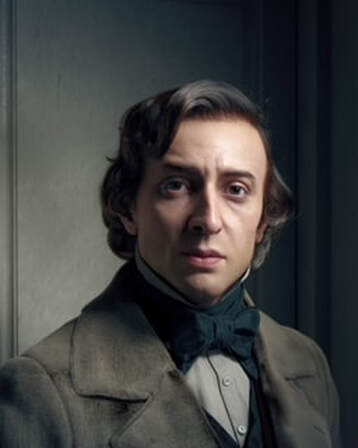
We are alike saddened and delighted in the disheartening narratives of Chopin’s music.
Chopin’s true merit lies in his fondness for folk-music, heartfelt music, simple but very beautiful, warm-hearted melody-lines, which, he would then infuse with “life and spirit” with the soul of the piano: the damper pedal.
With adroit manipulation of the damper pedal (sustain pedal) chords are therein spread-out through long intervals or whirling clusters of hovering notes (ghost notes, an army of shadows), or made resonant and sonorous with stunning plangent echoes, as though surging from a seance with the spirit realm.
If truth were told, the piano instrument, well-tempered clavier, in its most supernal qualities, “the stringboard” as set free by the soul of the damper pedal, should reproduce the “ghost-notes” of its surroundings, analogous to the phenomena of “magnetism” in the philosophy of Arthur Schopenhauer (Will in Nature) which, according to the “law of affinity” may echo back with the baffling, indeed uncanny, sibylline echoes from the “spirit world” a rather atavistic seance to avoiding the dry terminology of quantum physics, “other dimensions.”
Here lies the difference between an electronic keyboard and a sonorous piano.
Rapid Chromaticism: may remind us a doleful outcry from the unfathomable depths of the soul, hence why it seems to register the widest range of human emotions, often verging on paroxysm, agitation, despair, sadness, et al., or a sense of total immersion into the darkly realms of incomprehensibility or immeasurableness. At this point, I am at a loss for words.
I had not played that sad piece since my youth (November, 1994)
As we get older, so we seem to recast ourselves in the conceptualization of time, “precious memories,” and this is why we all love Chopin despite all the heartbreaking oxymorons: gloomy delight, doleful happiness, blissful sadness, viz., a persisten nostalgia, the “Paradise Lost” of those “queer souls” with a penchant for the melancholy side of life.
Therefore, it is not surprising that such souls, however in possession of an inner heaven in the music of yesterday, are said to be admirably endowed with the most feverish, indeed piercing feelings for life’s thrilling moments, but ours is —much to the detriment of such incorrigible romantics of Elysian worlds, idyllic scenes and platonic love— a world of stones and steel” to quoting Irene Cara, what a feeling!
And so we are told that even Sergie Rachmaninoff, in spite of his well-known chromatic binges amidst a juggernaut of altered chords and one thousand meandering melodies, had to seek out the help of a psychologist! Bravo! And what should I say of Robert Schumann?
I shall forgo any line on Byron’s penchant for mountaintops in Faust Part II by Goethe!
At any rate, Aristotle says that the philosopher’s forehead is often stamped with a melancholy frame of mind. Thanks goodness, some souls can reach the Mount Parnassus of joy and bliss as though aided by the lofty spirits of yore!
Chopin was alike feminine (check his Nocturnes) and forcibly masculine in his heroic Polonaises (In A flat). His strength was often the results of ailment and frailty. What a contradiction! Like most geniuses, he was a man of contradictions.
Take for instance the cheerful Waltzes, and how they ring with the fleeting moments of joy and nostalgia, could be ideal for a drawing room, a salon, a soirée in the snug, intimate gathering of kindred souls.
Good heaven! Nothing like remembering a boisterous party, Vals Brillante, is still lodged in my heart, like the cheeky smile of a beautiful woman!
The same transport of joy unto the nursing hands of sadness could be found in his incurably fickle Mazurkas, whose capricious daintiness and jauntiness could drive me mad for the subtle flirtatiousness of that Polish woman.
A Catholic, yes, but, my goodness, she can drive me nut! I am sure Chopin never got the apple’s reciprocity, and as a queer bird, a genius, a loner, he ended up hooking up with with a sullen matron: George Sand.
In 1995, I wrote a moving poem to a gnarled tree! I praised him for his long-endurance, fortitude and perseverance!
“My! After all these long-years, are you still standing there, defiant, resolute and strong?”
If you well remember Russian pianist Vladimir Horowitz? He played better as he got older. And so for me Horowitz is remembered as an old man, a sage, a master, an oak-tree buffeted by the long-winters of life.
Finally, winter is almost here in New York, and it seems to bring me the fondest memories of my former self.
Chopin’s true merit lies in his fondness for folk-music, heartfelt music, simple but very beautiful, warm-hearted melody-lines, which, he would then infuse with “life and spirit” with the soul of the piano: the damper pedal.
With adroit manipulation of the damper pedal (sustain pedal) chords are therein spread-out through long intervals or whirling clusters of hovering notes (ghost notes, an army of shadows), or made resonant and sonorous with stunning plangent echoes, as though surging from a seance with the spirit realm.
If truth were told, the piano instrument, well-tempered clavier, in its most supernal qualities, “the stringboard” as set free by the soul of the damper pedal, should reproduce the “ghost-notes” of its surroundings, analogous to the phenomena of “magnetism” in the philosophy of Arthur Schopenhauer (Will in Nature) which, according to the “law of affinity” may echo back with the baffling, indeed uncanny, sibylline echoes from the “spirit world” a rather atavistic seance to avoiding the dry terminology of quantum physics, “other dimensions.”
Here lies the difference between an electronic keyboard and a sonorous piano.
Rapid Chromaticism: may remind us a doleful outcry from the unfathomable depths of the soul, hence why it seems to register the widest range of human emotions, often verging on paroxysm, agitation, despair, sadness, et al., or a sense of total immersion into the darkly realms of incomprehensibility or immeasurableness. At this point, I am at a loss for words.
I had not played that sad piece since my youth (November, 1994)
As we get older, so we seem to recast ourselves in the conceptualization of time, “precious memories,” and this is why we all love Chopin despite all the heartbreaking oxymorons: gloomy delight, doleful happiness, blissful sadness, viz., a persisten nostalgia, the “Paradise Lost” of those “queer souls” with a penchant for the melancholy side of life.
Therefore, it is not surprising that such souls, however in possession of an inner heaven in the music of yesterday, are said to be admirably endowed with the most feverish, indeed piercing feelings for life’s thrilling moments, but ours is —much to the detriment of such incorrigible romantics of Elysian worlds, idyllic scenes and platonic love— a world of stones and steel” to quoting Irene Cara, what a feeling!
And so we are told that even Sergie Rachmaninoff, in spite of his well-known chromatic binges amidst a juggernaut of altered chords and one thousand meandering melodies, had to seek out the help of a psychologist! Bravo! And what should I say of Robert Schumann?
I shall forgo any line on Byron’s penchant for mountaintops in Faust Part II by Goethe!
At any rate, Aristotle says that the philosopher’s forehead is often stamped with a melancholy frame of mind. Thanks goodness, some souls can reach the Mount Parnassus of joy and bliss as though aided by the lofty spirits of yore!
Chopin was alike feminine (check his Nocturnes) and forcibly masculine in his heroic Polonaises (In A flat). His strength was often the results of ailment and frailty. What a contradiction! Like most geniuses, he was a man of contradictions.
Take for instance the cheerful Waltzes, and how they ring with the fleeting moments of joy and nostalgia, could be ideal for a drawing room, a salon, a soirée in the snug, intimate gathering of kindred souls.
Good heaven! Nothing like remembering a boisterous party, Vals Brillante, is still lodged in my heart, like the cheeky smile of a beautiful woman!
The same transport of joy unto the nursing hands of sadness could be found in his incurably fickle Mazurkas, whose capricious daintiness and jauntiness could drive me mad for the subtle flirtatiousness of that Polish woman.
A Catholic, yes, but, my goodness, she can drive me nut! I am sure Chopin never got the apple’s reciprocity, and as a queer bird, a genius, a loner, he ended up hooking up with with a sullen matron: George Sand.
In 1995, I wrote a moving poem to a gnarled tree! I praised him for his long-endurance, fortitude and perseverance!
“My! After all these long-years, are you still standing there, defiant, resolute and strong?”
If you well remember Russian pianist Vladimir Horowitz? He played better as he got older. And so for me Horowitz is remembered as an old man, a sage, a master, an oak-tree buffeted by the long-winters of life.
Finally, winter is almost here in New York, and it seems to bring me the fondest memories of my former self.
Spanish Version Version (translated by LinkedIn)
¿Por qué todos amamos a Chopin a pesar de las melodías desgarradoras?
Es cierto que parece que nos edifican las tristes experiencias del dolor, la pérdida y la decepción.
De ahí que Thomas Mann, al igual que Frederic Nietzsche, viera en el horno de los sufrimientos un elemento revitalizador de fuerza y creatividad que, en algunos casos, podía producir un compositor melancólico como Chopin.
Estamos tristes y encantados por igual con las narrativas desalentadoras de la música de Chopin.
El verdadero mérito de Chopin radica en su afición por la música folclórica, la música sentida, sencilla pero muy bella, las líneas melódicas cálidas, a las que luego infundiría "vida y espíritu" con el alma del piano: el pedal sordina.
Con una hábil manipulación del pedal de sordina (pedal de sustain), los acordes se extienden a través de largos intervalos o grupos giratorios de notas flotantes (notas fantasmas, un ejército de sombras), o se hacen resonantes y sonoros con impresionantes ecos planos, como si surgieran de una sesión de espiritismo con el reino espiritual.
Aquí radica la diferencia entre un teclado electrónico y un piano sonoro.
El cromatismo rápido puede recordarnos un grito triste desde las profundidades insondables del alma, de ahí que parezca registrar la más amplia gama de emociones humanas, a menudo al borde del paroxismo, la agitación, la desesperación, la tristeza, etc., o una sensación de inmersión total en los oscuros reinos de lo incomprensible o lo inconmensurable. Aquí me quedo sin palabras.
No había tocado esa triste pieza desde mi juventud (Noviembre de 1994)...
A medida que envejecemos, parece que nos reformulamos en la conceptualización del tiempo, "recuerdos preciosos", y es por eso que todos amamos a Chopin a pesar de todos los oxímorones desgarradores: deleite sombrío, felicidad triste, tristeza dichosa, es decir, una nostalgia persistente, el "Paraíso Perdido" de esas "almas raras" con una inclinación por el lado melancólico de la vida.
Por lo tanto, no es de extrañar que tales almas, por muy que estén en posesión de un cielo interior en la música de ayer, se diga que están admirablemente dotadas de los sentimientos más febriles, incluso penetrantes, por los momentos emocionantes de la vida, pero el nuestro es —en detrimento de esos románticos incorregibles de los mundos Elíseos, las escenas idílicas y el amor platónico— un mundo de piedras y acero", citando a Irene Cara, ¡Qué sensación!
Y así se nos dice que incluso Sergie Rachmaninoff, a pesar de sus conocidas borracheras cromáticas en medio de un monstruo de acordes alterados y mil melodías serpenteantes, tuvo que buscar la ayuda de un psicólogo. ¡Bravo! ¿Y qué decir de Robert Schumann?
¡Renunciaré a cualquier línea sobre la inclinación de Byron por las cimas de las montañas en Fausto Parte II de Goethe!
En cualquier caso, Aristóteles dice que la frente del filósofo suele estar marcada por un estado de ánimo melancólico.
¡Gracias a Dios, algunas almas pueden alcanzar el Monte Parnaso de alegría y bienaventuranza como si fueran ayudadas por los elevados espíritus de antaño!
Chopin era igualmente femenino (véase sus Nocturnos) y forzosamente masculino en sus heroicas Polonesas (En La bemol). Su fuerza era a menudo el resultado de la dolencia y la fragilidad. ¡Qué contradicción! Como la mayoría de los genios, era un hombre de contradicciones.
Tomemos, por ejemplo, los alegres valses, y cómo suenan con los fugaces momentos de alegría y nostalgia, podrían ser ideales para un salón, un salón, una velada en la reunión íntima y acogedora de almas gemelas.
¡Dios mío! Nada como recordar una fiesta bulliciosa, Vals Brillante, todavía está alojado en mi corazón, ¡como la sonrisa descarada de una mujer hermosa!
El mismo transporte de alegría a las manos nodrizas de la tristeza se podía encontrar en sus incurablemente volubles Mazurcas, cuya caprichosa delicadeza y jovialidad podían volverme loco por la sutil coquetería de esa mujer polaca.
Católica, sí, pero, Dios mío, ¡puede volverme loca! Estoy seguro de que Chopin nunca recibió la reciprocidad de la manzana, y como un pájaro raro, un genio, un solitario, terminó ligando con una matrona hosca: George Sand.
¡En 1995, escribí un conmovedor poema a un árbol nudoso! ¡Lo elogié por su larga resistencia, fortaleza y perseverancia!
"¡Vaya! Después de todos estos largos años, ¿sigues de pie allí, desafiante, resuelto y fuerte?"
¿Recuerdas bien al pianista ruso Vladimir Horowitz? Tocaba mejor a medida que envejecía. Y así, para mí, Horowitz es recordado como un anciano, un sabio, un maestro, un roble azotado por los largos inviernos de la vida.
Finalmente, el invierno está casi aquí en Nueva York, y parece que me trae los mejores recuerdos de mi antiguo yo.
Es cierto que parece que nos edifican las tristes experiencias del dolor, la pérdida y la decepción.
De ahí que Thomas Mann, al igual que Frederic Nietzsche, viera en el horno de los sufrimientos un elemento revitalizador de fuerza y creatividad que, en algunos casos, podía producir un compositor melancólico como Chopin.
Estamos tristes y encantados por igual con las narrativas desalentadoras de la música de Chopin.
El verdadero mérito de Chopin radica en su afición por la música folclórica, la música sentida, sencilla pero muy bella, las líneas melódicas cálidas, a las que luego infundiría "vida y espíritu" con el alma del piano: el pedal sordina.
Con una hábil manipulación del pedal de sordina (pedal de sustain), los acordes se extienden a través de largos intervalos o grupos giratorios de notas flotantes (notas fantasmas, un ejército de sombras), o se hacen resonantes y sonoros con impresionantes ecos planos, como si surgieran de una sesión de espiritismo con el reino espiritual.
Aquí radica la diferencia entre un teclado electrónico y un piano sonoro.
El cromatismo rápido puede recordarnos un grito triste desde las profundidades insondables del alma, de ahí que parezca registrar la más amplia gama de emociones humanas, a menudo al borde del paroxismo, la agitación, la desesperación, la tristeza, etc., o una sensación de inmersión total en los oscuros reinos de lo incomprensible o lo inconmensurable. Aquí me quedo sin palabras.
No había tocado esa triste pieza desde mi juventud (Noviembre de 1994)...
A medida que envejecemos, parece que nos reformulamos en la conceptualización del tiempo, "recuerdos preciosos", y es por eso que todos amamos a Chopin a pesar de todos los oxímorones desgarradores: deleite sombrío, felicidad triste, tristeza dichosa, es decir, una nostalgia persistente, el "Paraíso Perdido" de esas "almas raras" con una inclinación por el lado melancólico de la vida.
Por lo tanto, no es de extrañar que tales almas, por muy que estén en posesión de un cielo interior en la música de ayer, se diga que están admirablemente dotadas de los sentimientos más febriles, incluso penetrantes, por los momentos emocionantes de la vida, pero el nuestro es —en detrimento de esos románticos incorregibles de los mundos Elíseos, las escenas idílicas y el amor platónico— un mundo de piedras y acero", citando a Irene Cara, ¡Qué sensación!
Y así se nos dice que incluso Sergie Rachmaninoff, a pesar de sus conocidas borracheras cromáticas en medio de un monstruo de acordes alterados y mil melodías serpenteantes, tuvo que buscar la ayuda de un psicólogo. ¡Bravo! ¿Y qué decir de Robert Schumann?
¡Renunciaré a cualquier línea sobre la inclinación de Byron por las cimas de las montañas en Fausto Parte II de Goethe!
En cualquier caso, Aristóteles dice que la frente del filósofo suele estar marcada por un estado de ánimo melancólico.
¡Gracias a Dios, algunas almas pueden alcanzar el Monte Parnaso de alegría y bienaventuranza como si fueran ayudadas por los elevados espíritus de antaño!
Chopin era igualmente femenino (véase sus Nocturnos) y forzosamente masculino en sus heroicas Polonesas (En La bemol). Su fuerza era a menudo el resultado de la dolencia y la fragilidad. ¡Qué contradicción! Como la mayoría de los genios, era un hombre de contradicciones.
Tomemos, por ejemplo, los alegres valses, y cómo suenan con los fugaces momentos de alegría y nostalgia, podrían ser ideales para un salón, un salón, una velada en la reunión íntima y acogedora de almas gemelas.
¡Dios mío! Nada como recordar una fiesta bulliciosa, Vals Brillante, todavía está alojado en mi corazón, ¡como la sonrisa descarada de una mujer hermosa!
El mismo transporte de alegría a las manos nodrizas de la tristeza se podía encontrar en sus incurablemente volubles Mazurcas, cuya caprichosa delicadeza y jovialidad podían volverme loco por la sutil coquetería de esa mujer polaca.
Católica, sí, pero, Dios mío, ¡puede volverme loca! Estoy seguro de que Chopin nunca recibió la reciprocidad de la manzana, y como un pájaro raro, un genio, un solitario, terminó ligando con una matrona hosca: George Sand.
¡En 1995, escribí un conmovedor poema a un árbol nudoso! ¡Lo elogié por su larga resistencia, fortaleza y perseverancia!
"¡Vaya! Después de todos estos largos años, ¿sigues de pie allí, desafiante, resuelto y fuerte?"
¿Recuerdas bien al pianista ruso Vladimir Horowitz? Tocaba mejor a medida que envejecía. Y así, para mí, Horowitz es recordado como un anciano, un sabio, un maestro, un roble azotado por los largos inviernos de la vida.
Finalmente, el invierno está casi aquí en Nueva York, y parece que me trae los mejores recuerdos de mi antiguo yo.