I am still trying to comprehend the characters of some of my writings (Shanti Novel, 2010, not yet published). Yes, I am just a vehicle to an inner scribe, or perhaps, after all, we are just a medium under the instructions and inspiration of Muse, for I cannot say that I am always writing from the heart, much less that I am the sole author of every line and verse.
Something within all of us, a genie, rolling up in smoke, may propel us to move on, to seek new seashores, new perspectives, other mountaintops, other venues, perhaps another music waiting for kindred ears.
O my! How fortunate to find a lake, whose waters, however becalmed by serenest thoughts, could reflect the heaven of a virtuous life.
The impulse, so winged by the afflatus of Pegasus' pinions, may steer me forward, but I am not always aware of any deserved merit, or any virtue so as to find myself worthy of any special gift.
I am neither aware of any unique experience, or any other pregnant moment as not yet felt in the heart of other writers or artists. Our story may be conveyed with the fancy imagination of that gifted writer, at home with that language...so common to our ears, but may I say that these characters are total strangers to us?
--Not at all.
Human beings are vouchsafed with gifts, but by what merits is beyond my comprehension. Saints and rascals just pass on before my eyes, like a vaudeville, like a masquerade, but I cannot understand why some people are just good, while others are just downright scoundrels and ingrates.
The Canvas of My Life:
Afterwards, when I look back to my past, and thus dare search me for any coherence in the personal canvas of my life, I seem to have a better comprehensive view of the whole, the horizon of my prospects, but only in the juxtaposition of my negative experiences as greatly enhancing the other positive-side of happiness and joy.
Sufferings and disappointments have made me keenly aware of the priceless value of peace and contentment. My best consolation when dealing with disappointment is to look at it from the perspective of that great artist, so fond of glaucous hues, its negative side simply magnifies the other cheerful side of light and beauty.
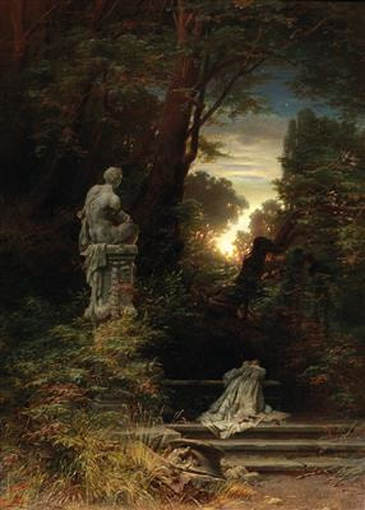
In some instances, some of my writings, like Ferdinand Knab's self-cornered depictions of Greco Roman ruins, may never see the light of day, much less bask under the sunshine of publicity.
At times, some characters seem to reveal their inner nature but only in the ever-rolling scroll of experiences, but sometimes they are as incomprehensible as it is the very drama of existence...
For the most part, we only meet people half-lit from one side, the other side of the face may remain dark under the pang of impervious shadows. Therefore, it behooves us all, to just be silent, and never be quick to passing judgement upon the character of a man or woman.
Here lies the greatness of Shakespeare and the chiaroscuros of Rembrandt. They were, first and foremost, psychologist par excellence. Their artistic output ought to be accessed as insightful pictures, aphorisms, maxims, photographic revelations on the unfathomable reaches of human nature.
The most intelligent people, therefore, while interacting with other human beings, seem to perceive the universals in every character, the individual --this coin or that nickel-- as the quintessential image of one thousand peoples' similar traits, virtues, rascality, well-known tendencies and penchants.
Hence the view of A. Schopenhauer and Shakespeare, that character is like an image forged on a coin. It may get rusty or old, but its most conspicuous features may prove to be long-lasting.
Thus, some minds could even predict the more likely outcomes in the random chances of circumstances. The drama of life would unfold but only as an assertion of our passions, our virtues, our faults. Those who fail to see this truth are simply considered to be grown-up fools, children. You must learn this hard truth of life, lest you lose your contest with those who defame you, and while pretending to be your friends, may even place stumbling blocks along the path of righteousness.
Poetic Justice:
https://en.m.wikipedia.org/wiki/Poetic_justice
Circumstances may exert much influence in the last outcomes of our peculiarities and idiosyncratic tendencies, but the inner scribe, our personality, is remarkably straightforward, bold, self-assertive, and the latter often happens but to corroborate the former.
Finding a trusting human being is a blessing. We entrust our precious belonging to those Cosechadores (Harvesters), and we have to celebrate our success with those who labor with us in the field of integrity, trust and excellence. Later, we shall collect the good fruits of our labor with joy and gratitude.
I send these essays to a wonderful person, a very ethical person, an editor, worth the trust of brothers in Christ, whose task is to tweak my writings wherever they would need some amelioration, but sometimes it is a perilous undertaking to paraphrase dictions without ruffling the flow of thoughts --the peculiar personality of the writer.
Errors are the ever-present homework for those who strive for any sense of improvement.
We may express our thoughts as though impelled by the passion and puissance of the moment, but sometimes we just don't reach the same fresh whirlpool, the green pastures, the path of righteousness along the tumbling brooks of gladness and delight.
I may have other desultory writings, essays, letters written between 2009 and 2014, and my task is to connect them whereat they may seem to find cohesiveness and meaning.
This cohesiveness may find its true meaning but in the long lapses of years, and even decades, quite often drifting away like the inexorable river of time, but also recurrent in the peculiar sequel that is assigned to every human being. This is the main reason why some books, the best ever written, are said to be the experiences of a long-lived life.
To gather ourselves in the recollection of moments, memories, experiences, and to arrange them according to the malleability of unfettered literature and art, is indeed a long painstaking process of critical self-examination, placid introspection and retrospection. Recasting our present by the moral lessons of the past is wisdom. Wise people would not be forgetful, and often they would vet the circumstances of the past to improving both the present and the future.
An ideal existence, free from the disturbance of din and noise, would find our mind's whirlpools the most agreeable when yielding the melodious music of peace and wellbeing.
Something within all of us, a genie, rolling up in smoke, may propel us to move on, to seek new seashores, new perspectives, other mountaintops, other venues, perhaps another music waiting for kindred ears.
O my! How fortunate to find a lake, whose waters, however becalmed by serenest thoughts, could reflect the heaven of a virtuous life.
The impulse, so winged by the afflatus of Pegasus' pinions, may steer me forward, but I am not always aware of any deserved merit, or any virtue so as to find myself worthy of any special gift.
I am neither aware of any unique experience, or any other pregnant moment as not yet felt in the heart of other writers or artists. Our story may be conveyed with the fancy imagination of that gifted writer, at home with that language...so common to our ears, but may I say that these characters are total strangers to us?
--Not at all.
Human beings are vouchsafed with gifts, but by what merits is beyond my comprehension. Saints and rascals just pass on before my eyes, like a vaudeville, like a masquerade, but I cannot understand why some people are just good, while others are just downright scoundrels and ingrates.
The Canvas of My Life:
Afterwards, when I look back to my past, and thus dare search me for any coherence in the personal canvas of my life, I seem to have a better comprehensive view of the whole, the horizon of my prospects, but only in the juxtaposition of my negative experiences as greatly enhancing the other positive-side of happiness and joy.
Sufferings and disappointments have made me keenly aware of the priceless value of peace and contentment. My best consolation when dealing with disappointment is to look at it from the perspective of that great artist, so fond of glaucous hues, its negative side simply magnifies the other cheerful side of light and beauty.
In some instances, some of my writings, like Ferdinand Knab's self-cornered depictions of Greco Roman ruins, may never see the light of day, much less bask under the sunshine of publicity.
At times, some characters seem to reveal their inner nature but only in the ever-rolling scroll of experiences, but sometimes they are as incomprehensible as it is the very drama of existence...
For the most part, we only meet people half-lit from one side, the other side of the face may remain dark under the pang of impervious shadows. Therefore, it behooves us all, to just be silent, and never be quick to passing judgement upon the character of a man or woman.
Here lies the greatness of Shakespeare and the chiaroscuros of Rembrandt. They were, first and foremost, psychologist par excellence. Their artistic output ought to be accessed as insightful pictures, aphorisms, maxims, photographic revelations on the unfathomable reaches of human nature.
The most intelligent people, therefore, while interacting with other human beings, seem to perceive the universals in every character, the individual --this coin or that nickel-- as the quintessential image of one thousand peoples' similar traits, virtues, rascality, well-known tendencies and penchants.
Hence the view of A. Schopenhauer and Shakespeare, that character is like an image forged on a coin. It may get rusty or old, but its most conspicuous features may prove to be long-lasting.
Thus, some minds could even predict the more likely outcomes in the random chances of circumstances. The drama of life would unfold but only as an assertion of our passions, our virtues, our faults. Those who fail to see this truth are simply considered to be grown-up fools, children. You must learn this hard truth of life, lest you lose your contest with those who defame you, and while pretending to be your friends, may even place stumbling blocks along the path of righteousness.
Poetic Justice:
https://en.m.wikipedia.org/wiki/Poetic_justice
Circumstances may exert much influence in the last outcomes of our peculiarities and idiosyncratic tendencies, but the inner scribe, our personality, is remarkably straightforward, bold, self-assertive, and the latter often happens but to corroborate the former.
Finding a trusting human being is a blessing. We entrust our precious belonging to those Cosechadores (Harvesters), and we have to celebrate our success with those who labor with us in the field of integrity, trust and excellence. Later, we shall collect the good fruits of our labor with joy and gratitude.
I send these essays to a wonderful person, a very ethical person, an editor, worth the trust of brothers in Christ, whose task is to tweak my writings wherever they would need some amelioration, but sometimes it is a perilous undertaking to paraphrase dictions without ruffling the flow of thoughts --the peculiar personality of the writer.
Errors are the ever-present homework for those who strive for any sense of improvement.
We may express our thoughts as though impelled by the passion and puissance of the moment, but sometimes we just don't reach the same fresh whirlpool, the green pastures, the path of righteousness along the tumbling brooks of gladness and delight.
I may have other desultory writings, essays, letters written between 2009 and 2014, and my task is to connect them whereat they may seem to find cohesiveness and meaning.
This cohesiveness may find its true meaning but in the long lapses of years, and even decades, quite often drifting away like the inexorable river of time, but also recurrent in the peculiar sequel that is assigned to every human being. This is the main reason why some books, the best ever written, are said to be the experiences of a long-lived life.
To gather ourselves in the recollection of moments, memories, experiences, and to arrange them according to the malleability of unfettered literature and art, is indeed a long painstaking process of critical self-examination, placid introspection and retrospection. Recasting our present by the moral lessons of the past is wisdom. Wise people would not be forgetful, and often they would vet the circumstances of the past to improving both the present and the future.
An ideal existence, free from the disturbance of din and noise, would find our mind's whirlpools the most agreeable when yielding the melodious music of peace and wellbeing.